 orecast
News & videos
New episodes and updates from ORECAST, straight from our data work and the YouTube channel.
Also: 25,000 m² of cellars beneath Nuremberg, where the imperial crown lay walled up in 1945 · Too deep for your detector: why the soil decides the find · Germany's Deepest Cave Lies Under the Untersberg – 1,149 Metres Down, and No One May Enter, All news →
Where ORECAST has data
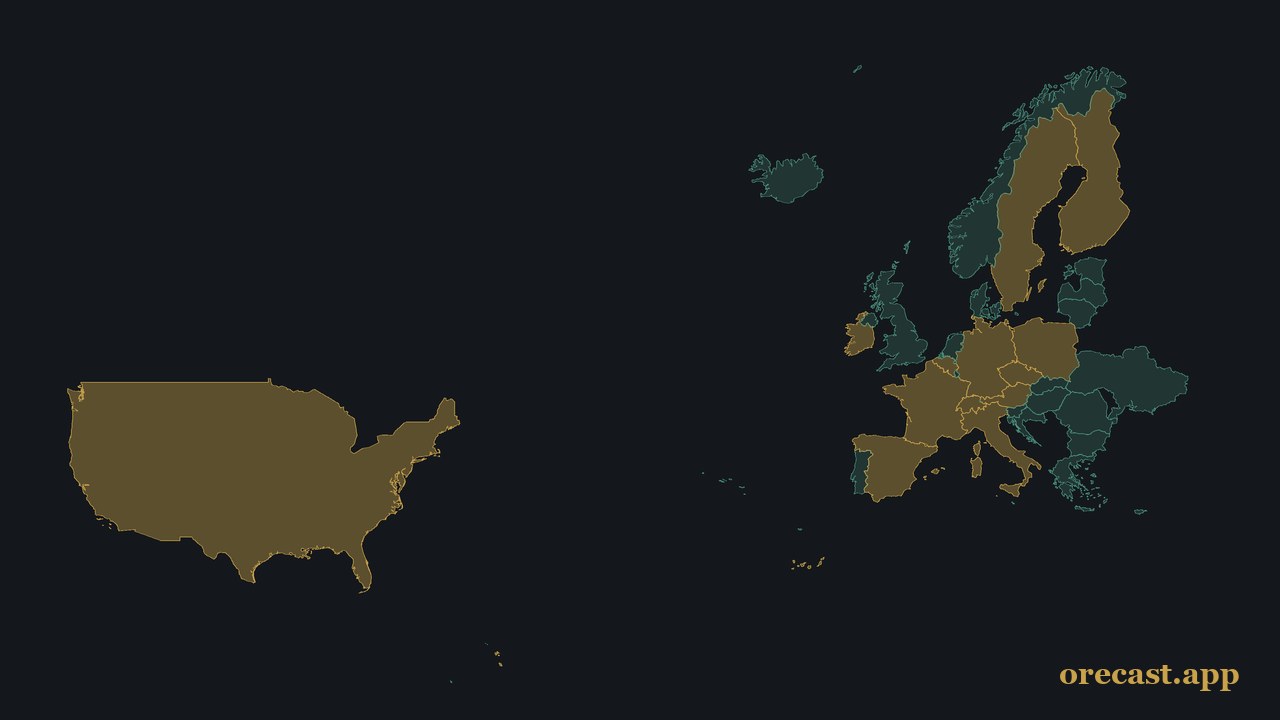
Everything runs from our own database. Across the EU, EFTA and the UK we hold fossils, historical & WWII sites and caves & mining; national mineral surveys add dense mineral data for the highlighted countries. Documented mineral points everywhere else come from USGS MRDS.
What you get
🪨 Minerals & ores
Recorded finds, plus what the local rock makes likely. You see where raw materials and gold could turn up, and we skip the made-up percentages.
🦴 Fossils
Fossil sites from the scientific record (PBDB and GBIF), each with its geological age, rock formation and source. Made for fossil hunting and rockhounding.
🏛️ History & archaeology
Archaeological sites, castles and other landmarks. Where old munitions might still be in the ground, you get a clear safety warning.
🧭 AI insight
Ask “what would I find if I dug here?” and get a plain-language answer. It's built only from the local data. Nothing is invented.
Popular regions
Pick a city to see the recorded finds, fossils and historical sites nearby.
Cologne · Munich · Freiberg (Ore Mountains) · Goslar (Harz) · Holzmaden · Freiburg (Black Forest) · Dresden · Trier · Paris · Vienna · Rome · Milan · Antwerp
All 43 regions →
Topic guides
Guides to real regions, backed by documented finds and the local geology.
Find fossils near me · Gold panning near me · Rockhounding near me · How to identify fossils · Identify rocks & minerals · Collecting: allowed or not? · Gold & ore in the Harz · Silver in the Ore Mountains · Fossils of the Swabian Alb · Gold in the Black Forest · Volcanoes of the Eifel · Fossils in Solnhofen & the Altmühl valley · Gold panning in the Alps · Fossils in the Ruhr area · Finding amber on the Baltic coast · Agate & gemstones in Idar-Oberstein
The right gear for it →
To take with you
For your next day out: a verified map and the permission form you need beforehand.
🗺️ Treasure Map Germany
32 individually verified places in Germany for fossils, minerals and gold, each with a traffic light (collect yourself, with rules, look only), a fact sheet and the legal situation per state. 33 pages as a PDF, in German, €12.90.
📋 The finds folder
A landowner permission form to tick through and a find report sheet, as fillable PDFs. Free.
Treasure hunting that starts with real data
Wondering where to find gold, minerals or fossils near you? A lot of “treasure map” sites simply guess. ORECAST looks at recorded mineral occurrences and the geology underneath, then separates what's genuinely on file at a spot from what the rock merely makes possible. That's what makes it handy for gold prospecting, rockhounding and fossil hunting across Europe.
We try not to oversell. A promising rock type is not the same as a find, and you'll never see a made-up number here. Bear in mind that digging and collecting are regulated almost everywhere, protected monuments are off-limits, and old battlegrounds can still hold live munitions. ORECAST points these things out, but it can't give you permission.
Free, no account needed.
FAQ
What is ORECAST?
A free map that shows what is documented beneath any point in Europe: minerals and gold, fossils, caves and old mining, geosites, historical places and traces of the Second World War. It is built from recorded data and geology rather than guesswork.
Where can I find gold?
ORECAST marks where gold is actually on record and where the geology only makes it possible, such as river placers. It will not promise you gold; likely rock is not the same as a find.
Is ORECAST free?
The map with every find spot is free and works without an account, and so is a limited number of AI assessments. Your own finds, likes and comments need a free account. ORECAST Pro adds unlimited AI assessments, individual special layers such as the gold-panning rivers, offline areas for the field and GPX export, and removes the ads in the app. The website is cookieless and free of third-party tracking; the free app shows non-personalised ads.
Which areas are covered?
Documented mineral points worldwide come from USGS MRDS. For Europe we add dense data from the national geological surveys for Germany, France, Spain, Italy, Belgium and Austria, as well as Switzerland, Sweden, Finland, Ireland, Czechia and Poland. The geology beneath a point comes from the BGR 1:250,000 overview map in Germany and from the joint map of the geological surveys (EGDI) in 23 European countries. In the USA we show more than 260,000 documented occurrences, the geology of the 48 contiguous states and old mining from historical USGS maps, such as adits, shafts and prospect pits. Fossils and historical sites are so far available for Europe only.
Am I allowed to search and collect anywhere?
No. Collecting, metal detecting and gold panning are regulated almost everywhere in Europe and usually need a permit. ORECAST shows what applies in twelve countries and all sixteen German federal states, plus protected areas and historical sites. The app gives you information, not permission.
Can I show my own finds?
Yes. You store finds privately and to the metre; if you choose to share, they appear anonymously on the map after review, coarsened to about five kilometres. Others can like and comment on them, and every comment passes an AI check first.