 orecast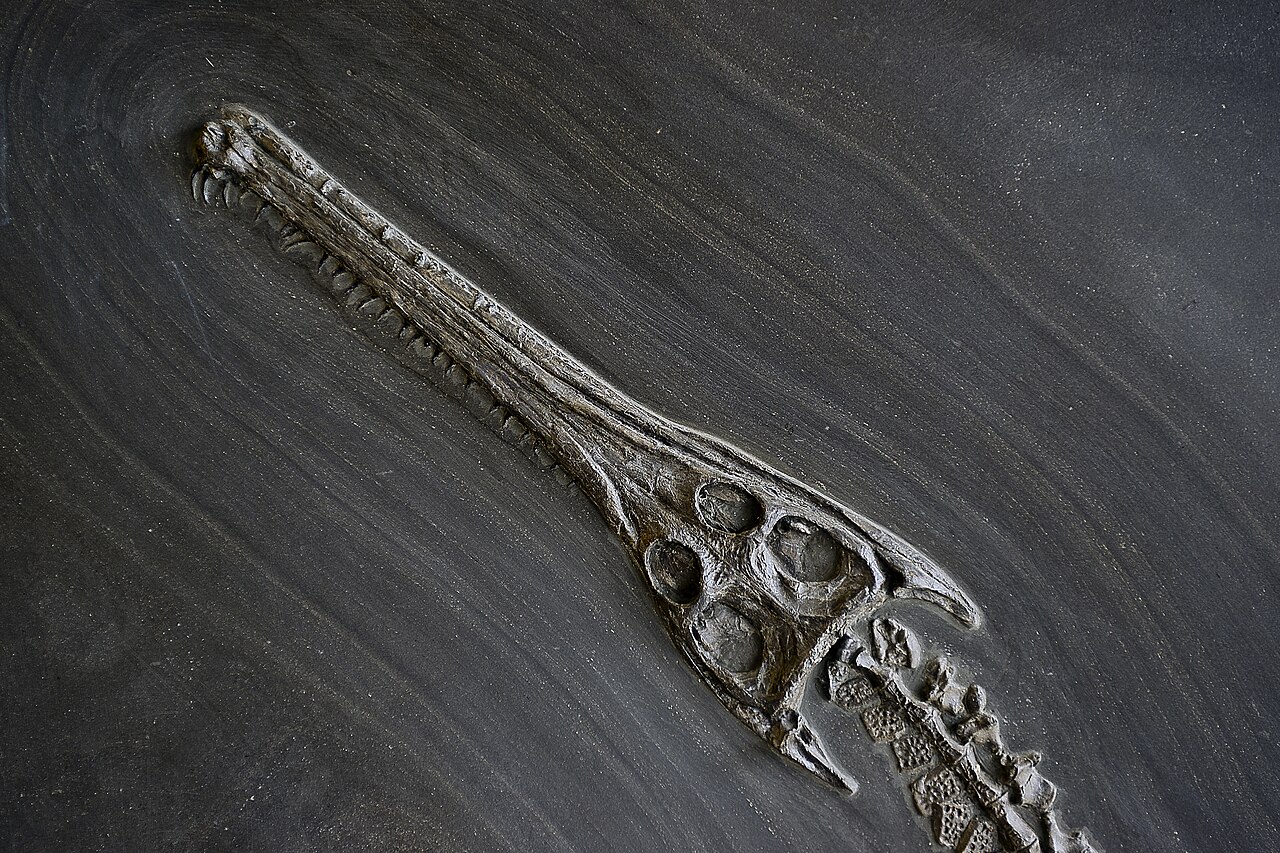
Around 180 million years ago an oxygen-poor Jurassic sea preserved life here exceptionally well. The Posidonia Shale still yields spectacular finds today. ORECAST shows the documented fossil sites nearby and makes clear where legal, often fee-based collecting on designated sites is possible and where it is not.
The heart of it all lies below the Alb escarpment between Holzmaden and Ohmden. The Urwelt-Museum Hauff in Holzmaden displays what this shale can hold: ichthyosaurs several metres long, pterosaurs, marine crocodiles and a fossil sea lily colony covering roughly a hundred square metres, one of the largest slabs of its kind anywhere. Next door, the Kromer shale quarry in Ohmden runs a public splitting site where visitors pay a small fee and work genuine Posidonia Shale themselves, the same rock the museum pieces came out of.
Dotternhausen, further south-west at the foot of the Plettenberg, offers a similar setup. The fossil museum there belongs to the cement works and sits right beside the active shale quarry, and its splitting field is stocked with fresh slabs. Realistic finds at both places are small ammonites of the genus Dactylioceras, belemnite rostra and the occasional fish scale. One local rule is worth asking about on site: exceptional pieces of scientific value may need to be shown to the operators or reported, a point German state heritage law takes seriously.
It pays to arrive with grounded expectations. The showpieces in the display cases came from professional excavations and carry hundreds of hours of preparation work per slab. On a public splitting site, a clean five-centimetre ammonite makes a good afternoon. That still means holding something no living creature has seen for 180 million years, split open by your own hand. Tools can usually be rented at the sites; sturdy shoes and a bit of patience you bring yourself.
Documented finds nearby
- BGR BSK1000: ÖlschieferÖlschiefer · source: BGR BSK10001.5 km
- zwischen Holzmaden und AichelbergNaturwerksteine - prognostiziert · prognostiziert · depth KMR50 L 7322-RV2.2, Bearbeitung 2008 · source: LGRB BW - Rohstoffvorkommen KMR501.8 km
- zwischen Schlierbach, Ohmden und Zell unter AichelbergNaturwerksteine - prognostiziert · prognostiziert · depth KMR50 L 7322-RV1.4, Bearbeitung 2008 · source: LGRB BW - Rohstoffvorkommen KMR501.8 km
- ostnordöstlich HolzmadenNaturwerksteine - nachgewiesen · nachgewiesen · depth KMR50 L 7322-RV2.1, Bearbeitung 2008 · source: LGRB BW - Rohstoffvorkommen KMR502.6 km
- östlich HolzmadenNaturwerksteine - nachgewiesen · nachgewiesen · depth KMR50 L 7322-RV2.3, Bearbeitung 2008 · source: LGRB BW - Rohstoffvorkommen KMR502.8 km
- BGR BSK1000: Ton, TonsteinTon, Tonstein · source: BGR BSK10002.9 km
- Salzgesteine, fraglichSalzgesteine, fraglich · fraglich · depth unter Tage, zwischen Bohrungen interpoliert · source: LGRB BW - Rohstoffvorkommen unter Tage3.2 km
- ca. 1,5 km südsüdöstlich SchlierbachNaturwerksteine - nachgewiesen · nachgewiesen · depth KMR50 L 7322-RV1.1, Bearbeitung 2008 · source: LGRB BW - Rohstoffvorkommen KMR503.7 km
- 1 km nordöstlich OhmdenNaturwerksteine - nachgewiesen · nachgewiesen · depth KMR50 L 7322-RV1.2, Bearbeitung 2008 · source: LGRB BW - Rohstoffvorkommen KMR503.9 km
- 1 km westlich Zell unter AichelbergNaturwerksteine - nachgewiesen · nachgewiesen · depth KMR50 L 7322-RV1.3, Bearbeitung 2008 · source: LGRB BW - Rohstoffvorkommen KMR504.9 km
- BGR BSK1000: Ton, TonsteinTon, Tonstein · source: BGR BSK10004.9 km
- BGR BSK1000: Kalkstein und DolomitsteinKalkstein und Dolomitstein · source: BGR BSK10005.4 km
- BGR BSK1000: Kalkstein und DolomitsteinKalkstein und Dolomitstein · source: BGR BSK10006.2 km
- nordöstlich BollÖlschiefer - nachgewiesen · nachgewiesen · depth KMR50 L 7322-RV3, Bearbeitung 2008 · source: LGRB BW - Rohstoffvorkommen KMR508.6 km
Fossil sites nearby
- Holzmaden, G. Fischer quarry, epsilon II-10 (SMNS collection)Falciferum · source: PBDB0.7 km
- Holzmaden, Ohmden quarry, epsilon II-2 (SMNS collection)Tenuicostatum · source: PBDB0.7 km
- Holzmaden, epsilon II-4, 1.5 m above Fleins (SMNS collection)Tenuicostatum · source: PBDB0.7 km
- Holzmaden, epsilon II-5 (SMNS collection)Falciferum · source: PBDB0.7 km
- Holzmaden, Fischer quarry, epsilon II-3 (SMNS collection)Tenuicostatum · source: PBDB0.7 km
- Holzmaden, epsilon II-8 or 9 (SMNS collection)Falciferum · source: PBDB0.7 km
- Holzmaden (Ansorge coll)Early Toarcian · Posidonia Shale · source: PBDB0.7 km
- Posidonia Shale, Holzmaden (Winterthur collection)Toarcian · source: PBDB0.7 km
- Holzmaden (Tubingen collection)Early Toarcian · source: PBDB0.7 km
- Holzmaden, G. Fischer quarry, epsilon II-12 (SMNS collection)Falciferum · source: PBDB0.7 km
Collecting, law & safety
A promising geology is never a guarantee, and you will not find invented numbers here. Collecting and digging are regulated across Europe and usually need a permit. Protected sites, nature reserves and disused mines are off-limits and can be deadly.
Affiliate links: buying through them earns ORECAST a small commission, your price stays the same. As an Amazon Associate, ORECAST earns from qualifying purchases. All recommendations →
Frequently asked questions
Where may I collect fossils on the Swabian Alb?
At designated collecting sites, such as some quarries, often for a fee and with clear rules. Protected areas and private land are off-limits. Ask the operator or municipality beforehand.
Which fossils occur here?
Mostly ammonites and belemnites, more rarely sea lilies, fish and marine reptiles from the Lower Jurassic, the Posidonia Shale.
Do I need special tools?
For most sites a hammer, chisel and safety goggles are enough. Permission and caution matter more, because quarries are dangerous.
More guides:
Gold & ore in the Harz · Silver & minerals in the Ore Mountains · Gold & minerals in the Black Forest · Volcanoes & geology of the Eifel · Fossils in Solnhofen & the Altmühl valley · Gold panning in the Alps & Austria · Fossils in the Ruhr area · Finding amber on the Baltic coast · Agate & gemstones in Idar-Oberstein · Find fossils near me · Gold panning near me · Rockhounding near me · How to identify fossils · How to identify rocks and minerals · Collecting fossils and minerals: allowed or not?