 orecast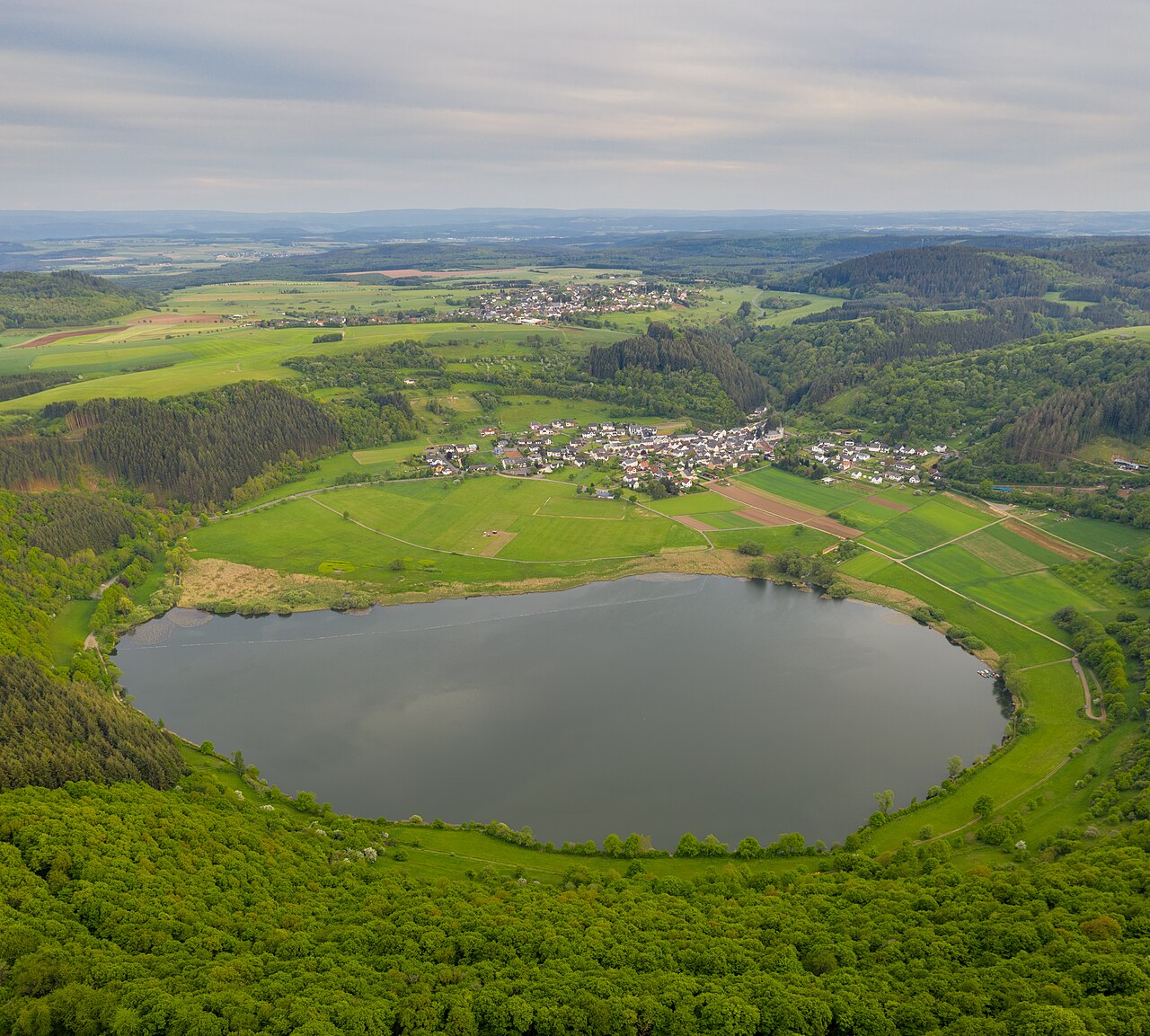
Eifel volcanism is geologically very young. The last eruption at the Laacher See lies only about 11,000 years back, and specialists consider it dormant rather than extinct. Maars, basalt, pumice and CO2-rich springs shape the landscape. The draw here is spectacular geology more than treasure. ORECAST shows geosites, documented occurrences and historical sites nearby.
The full range of that volcanism fits into a short drive. Near Mendig, the Wingertsberg wall exposes the deposits of the Laacher See eruption in layers many metres thick, one of the most studied volcanic outcrops in Europe. Beneath the town, the Lavakeller cellars follow old basalt workings deep under the streets, while the Lava Dome centre above ground explains what happened when the volcano blew. Around Daun the maars line up: the Gemündener, Weinfelder and Schalkenmehrener Maar sit within sight of each other, and the Ulmener Maar counts as Germany's youngest volcanic crater.
Collectors have material to look for as well. The pumice beds around the Laacher See yield deep blue hauyne and clear sanidine crystals, and at the Dreiser Weiher rising magma carried olive-green olivine nodules up from the Earth's mantle. The Maarmuseum in Manderscheid and the volcano museum in Daun put such finds in context. If you prefer geology in motion, the Brubbel in Wallenborn pushes up a column of water roughly every half hour, driven by volcanic carbon dioxide, and the same mechanism feeds the Andernach geyser on the Rhine, the tallest cold-water geyser on record.
What you need here is less equipment than decent boots. The Vulkaneifel has been a UNESCO Global Geopark since 2015, with marked geo-trails and guided excursions that reach outcrops you could not visit on your own. Much of it opens up on an ordinary hike, though. One look at a wall of lapilli beside the trail is enough to grasp how young this landscape is. In geological terms, all of this happened yesterday.
Documented finds nearby
- Lavagrube "Radersberg bei Brueck" / "BrUeck 1"oberflächennaher Rohstoff · Abbau mindestens in einem Teilbereich (nachgewiesene Bauwürdigkeit), LGB-Kategorie 1b · source: LGB RLP - Rohstoffsicherung, Abbauflächen (Kat. 1a/1b)3 km
- BGR BSK1000: Vulkanische LockergesteineVulkanische Lockergesteine · source: BGR BSK10003.2 km
- BGR BSK1000: Kalkstein und DolomitsteinKalkstein und Dolomitstein · source: BGR BSK10005.2 km
- Dreimuellerwaldoberflächennaher Rohstoff · Abbau mindestens in einem Teilbereich (nachgewiesene Bauwürdigkeit), LGB-Kategorie 1b · source: LGB RLP - Rohstoffsicherung, Abbauflächen (Kat. 1a/1b)5.6 km
- Kalksteinbruch Ahbach - Koreaoberflächennaher Rohstoff · Abbau mindestens in einem Teilbereich (nachgewiesene Bauwürdigkeit), LGB-Kategorie 1b · source: LGB RLP - Rohstoffsicherung, Abbauflächen (Kat. 1a/1b)6.1 km
- Kalksteinbruch "Muehlenbach"oberflächennaher Rohstoff · Abbau mindestens in einem Teilbereich (nachgewiesene Bauwürdigkeit), LGB-Kategorie 1b · source: LGB RLP - Rohstoffsicherung, Abbauflächen (Kat. 1a/1b)6.6 km
- Kalksteinbruch "Meerbuesch I-IV"oberflächennaher Rohstoff · Abbau mindestens in einem Teilbereich (nachgewiesene Bauwürdigkeit), LGB-Kategorie 1b · source: LGB RLP - Rohstoffsicherung, Abbauflächen (Kat. 1a/1b)7.1 km
- Lavagrube "Oberehe 2" (Doehm-Berg)oberflächennaher Rohstoff · Abbau mindestens in einem Teilbereich (nachgewiesene Bauwürdigkeit), LGB-Kategorie 1b · source: LGB RLP - Rohstoffsicherung, Abbauflächen (Kat. 1a/1b)7.3 km
- Dockweiler 11 Suedoberflächennaher Rohstoff · Abbau mindestens in einem Teilbereich (nachgewiesene Bauwürdigkeit), LGB-Kategorie 1b · source: LGB RLP - Rohstoffsicherung, Abbauflächen (Kat. 1a/1b)7.6 km
- Lavabruch "Dockweiler 11"oberflächennaher Rohstoff · Abbau mindestens in einem Teilbereich (nachgewiesene Bauwürdigkeit), LGB-Kategorie 1b · source: LGB RLP - Rohstoffsicherung, Abbauflächen (Kat. 1a/1b)7.7 km
- Hinterweiler 5oberflächennaher Rohstoff · Abbau mindestens in einem Teilbereich (nachgewiesene Bauwürdigkeit), LGB-Kategorie 1b · source: LGB RLP - Rohstoffsicherung, Abbauflächen (Kat. 1a/1b)8.4 km
- Kalksteine der Eifel-Stufe - Kalk- und Mergelstein, dünn- bis dickbankig, tw. massig, wechsellagernd mit Ton-, Schluff- und Feinsandstein. (Eignung: Edelsplitt, Splitt, Schotter, Mineralstoffgemisch, Düngekalk)Karbonatgestein · source: GD NRW RK50 FG8.5 km
- Betteldorf Lavagruben / Betteldorf 1oberflächennaher Rohstoff · Abbau mindestens in einem Teilbereich (nachgewiesene Bauwürdigkeit), LGB-Kategorie 1b · source: LGB RLP - Rohstoffsicherung, Abbauflächen (Kat. 1a/1b)8.8 km
- Basaltsteinbruch "Hohenfels 11" - Muehlenbergoberflächennaher Rohstoff · Abbau mindestens in einem Teilbereich (nachgewiesene Bauwürdigkeit), LGB-Kategorie 1b · source: LGB RLP - Rohstoffsicherung, Abbauflächen (Kat. 1a/1b)8.9 km
Fossil sites nearby
- Wotan Quarry, south of Ahütte, west of NohnEarly Givetian · Ahbach · source: PBDB6.3 km
- Wotan Quarry, south of Ahütte, west of NohnEarly Givetian · Ahbach · source: PBDB6.3 km
- nordwestlich Niederehe, Üxheim, Hillesheim-Mulde, EifelGivetian · Kerpen · source: PBDB7 km
- Northeastern flank of the Hillesheim SynclineEarly Eifelian · Lauch · source: PBDB7.5 km
- Leudendorf near Uxheim, "Hillesheimer Mulde", "Eifelkalkmulden".Early Eifelian · Lauch · source: PBDB8 km
- ÜxheimGivetian · Curten · source: PBDB8 km
- Üxheim 1, Heisdorf Formation (siltstone)Emsian · Heisdorf · source: PBDB8 km
- Üxheim 1, Heisdorf Formation (limestone)Emsian · Heisdorf · source: PBDB8 km
- Üxheim 1, Lauch FmEifelian · Lauch · source: PBDB8 km
- Kirberg Hill, Hillesheim SynclineEarly Eifelian · Nohn · source: PBDB8 km
Collecting, law & safety
A promising geology is never a guarantee, and you will not find invented numbers here. Collecting and digging are regulated across Europe and usually need a permit. Protected sites, nature reserves and disused mines are off-limits and can be deadly.
Affiliate links: buying through them earns ORECAST a small commission, your price stays the same. As an Amazon Associate, ORECAST earns from qualifying purchases. All recommendations →
Frequently asked questions
Are the Eifel volcanoes still active?
They count as dormant, not extinct. The last eruption was around 11,000 years ago. Rising carbon dioxide in springs and mofettes shows there is still movement below.
What can you discover geologically in the Eifel?
Maars, the volcanic crater lakes, plus basalt and pumice deposits, mineral springs and many geosites. The map shows them nearby.
May I collect rocks?
Loose samples outside protected areas are often allowed, but geosites and nature reserves stay off-limits. Never in quarries without permission.
More guides:
Gold & ore in the Harz · Silver & minerals in the Ore Mountains · Fossils of the Swabian Alb · Gold & minerals in the Black Forest · Fossils in Solnhofen & the Altmühl valley · Gold panning in the Alps & Austria · Fossils in the Ruhr area · Finding amber on the Baltic coast · Agate & gemstones in Idar-Oberstein · Find fossils near me · Gold panning near me · Rockhounding near me · How to identify fossils · How to identify rocks and minerals · Collecting fossils and minerals: allowed or not?