 orecast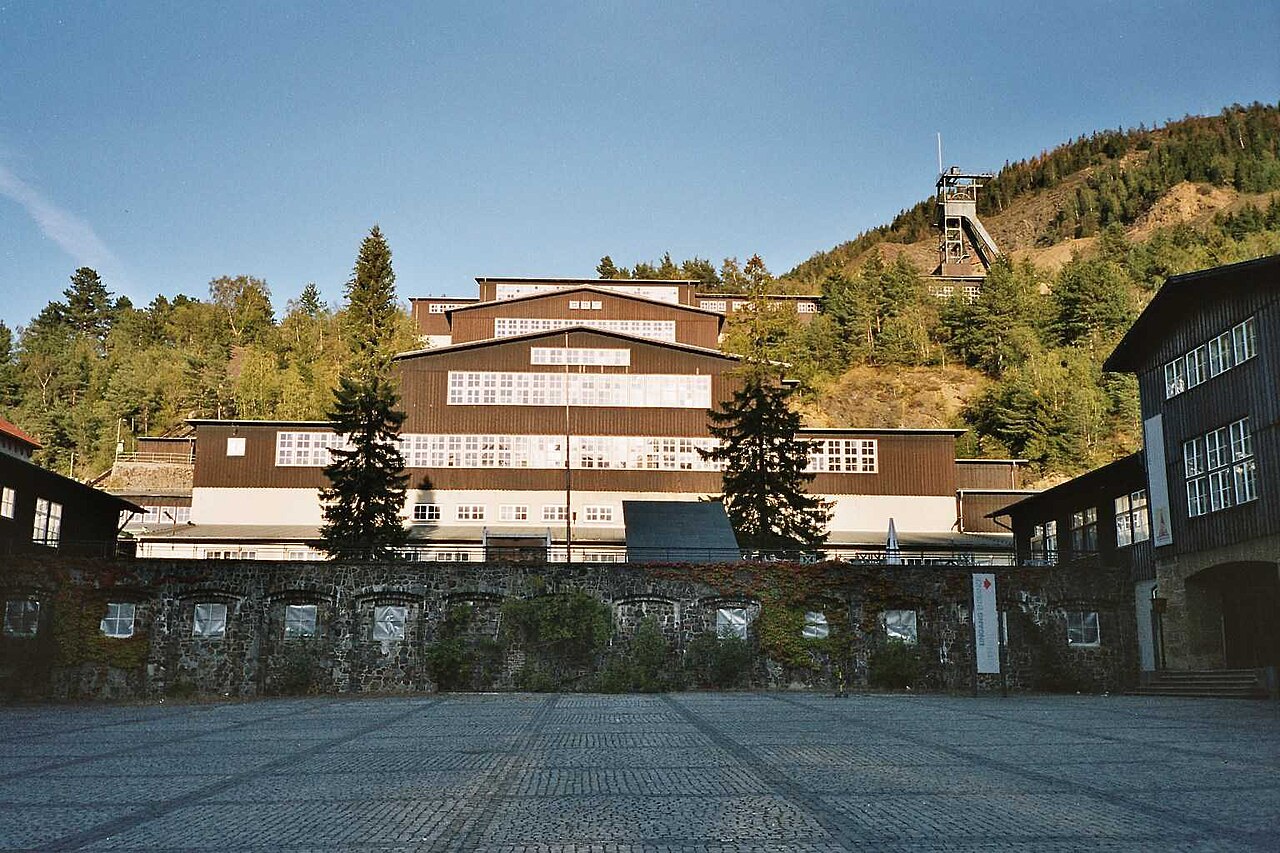
The Rammelsberg hill above Goslar holds one of Europe's largest deposits of sedimentary base-metal ore. It formed in the Devonian on the floor of a marine basin, where hot, metal-rich brines vented and laid down finely banded ore carrying lead, zinc, copper and silver; the Variscan mountain building later folded the whole package into the northern edge of the Harz. Around 27 million tonnes of ore came out of the hill over the centuries.
Few mines anywhere ran for so long. The chronicler Widukind of Corvey mentioned silver extraction in the Harz in 968, and the last shift at the Rammelsberg ended in 1988, a good thousand years later. That wealth explains why medieval emperors kept a palace in Goslar. UNESCO listed the mine together with the old town as World Heritage in 1992 and added the Upper Harz Water Management System in 2010, a network of ponds and ditches that once powered the pits with water wheels.
The Rammelsberg works today as a museum and show mine, with underground tours passing the vividly coloured vitriol crusts that seeping ore solutions leave on the gallery walls. Within a short drive, the dumps of the Upper Harz vein mining around Clausthal-Zellerfeld and Lautenthal have documented galena, sphalerite, barite and calcite, and old slate quarries line the rim of the mountains. ORECAST maps the documented localities around Goslar, including dumps with described mineral lists.
The Harz demands caution. Many dumps belong to the World Heritage area or are otherwise protected, so collecting needs permission, and inside the Harz National Park it is banned outright. Guided collecting trips are the simplest legal route. The mountains are riddled with a thousand years of workings; open adits, shafts and collapse pits are life-threatening and never to be entered.
Minerals & raw materials near Goslar (Harz)
Within 30 km of Goslar (Harz) our database holds 140 documented mineral and ore points. The most common commodities nearby:
Documented finds nearby
- Rammelsberg Zn - Pb - Cu MineBaryt, Blei, Kupfer, Silber, Zink · active producer · source: USGS MRDS1 km
- RammelsbergBlei, Gold, Kupfer, Silber, Zink · former producer · source: USGS MRDS1.1 km
- BGR BSK1000: Kies und SandKies und Sand · source: BGR BSK10004.4 km
- BGR BSK1000: Kalkstein und DolomitsteinKalkstein und Dolomitstein · source: BGR BSK10006.3 km
- RammelsbergSilber, Zink, Blei · stillgelegt · source: BGR GK2000 - Lagerstätten6.5 km
- BGR BSK1000: Kies und SandKies und Sand · source: BGR BSK10007.3 km
- BGR BSK1000: Sandstein und GrauwackeSandstein und Grauwacke · source: BGR BSK10007.7 km
- BGR BSK1000: Kalkstein und DolomitsteinKalkstein und Dolomitstein · source: BGR BSK10008.4 km
- Bad Harzburg Nickel Prospect-GermanyKupfer, Nickel · occurrence · source: USGS MRDS9 km
- BGR BSK1000: TiefengesteineTiefengesteine · source: BGR BSK100010.3 km
- BGR BSK1000: Sandstein und GrauwackeSandstein und Grauwacke · source: BGR BSK100011.1 km
- BGR BSK1000: Kalkstein und DolomitsteinKalkstein und Dolomitstein · source: BGR BSK100011.1 km
- KiessandKiessand · source: LAGB Sachsen-Anhalt - Oberflächennahe Rohstoffe (KOR50)13.1 km
- KiessandKiessand · source: LAGB Sachsen-Anhalt - Oberflächennahe Rohstoffe (KOR50)13.3 km
What the ground is made of
Official soil maps cover 99 % of the area within the radius. Each list names its source and refers to the part of that area the source describes. Where layers overlap, shares can add up to more than 100 %.
Soil types
Source: LAGB Sachsen-Anhalt VBK50, LBEG Niedersachsen BK50.
Fossils near Goslar (Harz)
- PetersbergConiacian · source: PBDB0.8 km
- Temporary road exposure near GoslarLate Aalenian · source: PBDB1.3 km
- SudmerbergConiacian · "Siphonia Marl" · source: PBDB2.9 km
- Rohstoffbetriebe Oker quarry, bed 83, LangenbergLate Kimmeridgian · Süntel · source: PBDB3.9 km
- Rohstoffbetriebe Oker quarry, spoil pile, LangenbergLate Kimmeridgian · Süntel · source: PBDB3.9 km
- Sudmer Berg 2, bei GoslarMiddle Pleistocene · source: PBDB4 km
- Hansa iron mine at HarlingerodeMiddle Callovian · source: PBDB5 km
- Langenberg, OkerEarly Kimmeridgian · Süntel · source: PBDB5 km
- Rohstoffbetriebe Oker quarry, bed 47, LangenbergKimmeridgian · Lower Kimmeridge marls · source: PBDB5.3 km
- Rohstoffbetriebe Oker quarry, bed 49, LangenbergKimmeridgian · Lower Kimmeridge marls · source: PBDB5.3 km
History & archaeology near Goslar (Harz)
- Stiftskirche St. Simon und Judasarchaeological0.3 km
- St. Thomasarchaeological0.3 km
- Kaiserhauscastle_monument0.4 km
- Rosentorcastle_monument0.4 km
- Vititorcastle_monument0.6 km
- Stiftsruine St. Georgarchaeological0.6 km
- Bergdorfruinearchaeological0.7 km
- Breites Torcastle_monument0.8 km
- Stiftskirche St. Peterarchaeological1.4 km
- St.-Peters-Stiftarchaeological1.4 km
Treasure hunting, law & safety
We'd rather underclaim than oversell: a promising geology is no guarantee, and you won't find invented numbers here. Digging and collecting are regulated across Europe and usually need a permit, and protected monuments and nature reserves are off-limits.
Frequently asked questions
Can I dig or collect finds near Goslar (Harz)?
Digging and collecting finds are regulated in most of Europe and usually need a permit; protected monuments and nature reserves are off-limits. ORECAST shows where protected/historical sites lie so you can check the local rules first. It is information, not a permit.
Where can I find gold near Goslar (Harz)?
Around Goslar (Harz), gold is at most plausible as river placer (hobby-scale panning), not a documented deposit unless flagged on the map. ORECAST clearly separates documented finds from merely plausible geology, and it never promises gold.
What minerals and raw materials occur near Goslar (Harz)?
Within 30 km we list 140 documented mineral/ore points. The most common nearby are: Kiessand, Basit, Kalkstein, Ton, Kalkstein und Dolomitstein.
Are there fossils near Goslar (Harz)?
Yes, 164 scientific fossil localities are recorded within 30 km (with geological age and formation).
Is digging dangerous near Goslar (Harz)?
Possibly: former war zones can hold unexploded ordnance. Where a site is flagged with the ☢️ warning, never dig, it is a danger to life; contact the bomb-disposal service if in doubt.
Identify & compare:
Identify fossils · Identify rocks & minerals · Find gold · Find silver · Find gemstones · App comparison
Explore other regions:
the Harz · Hanover · Kassel · Hamburg · Leipzig · Frankfurt