 orecast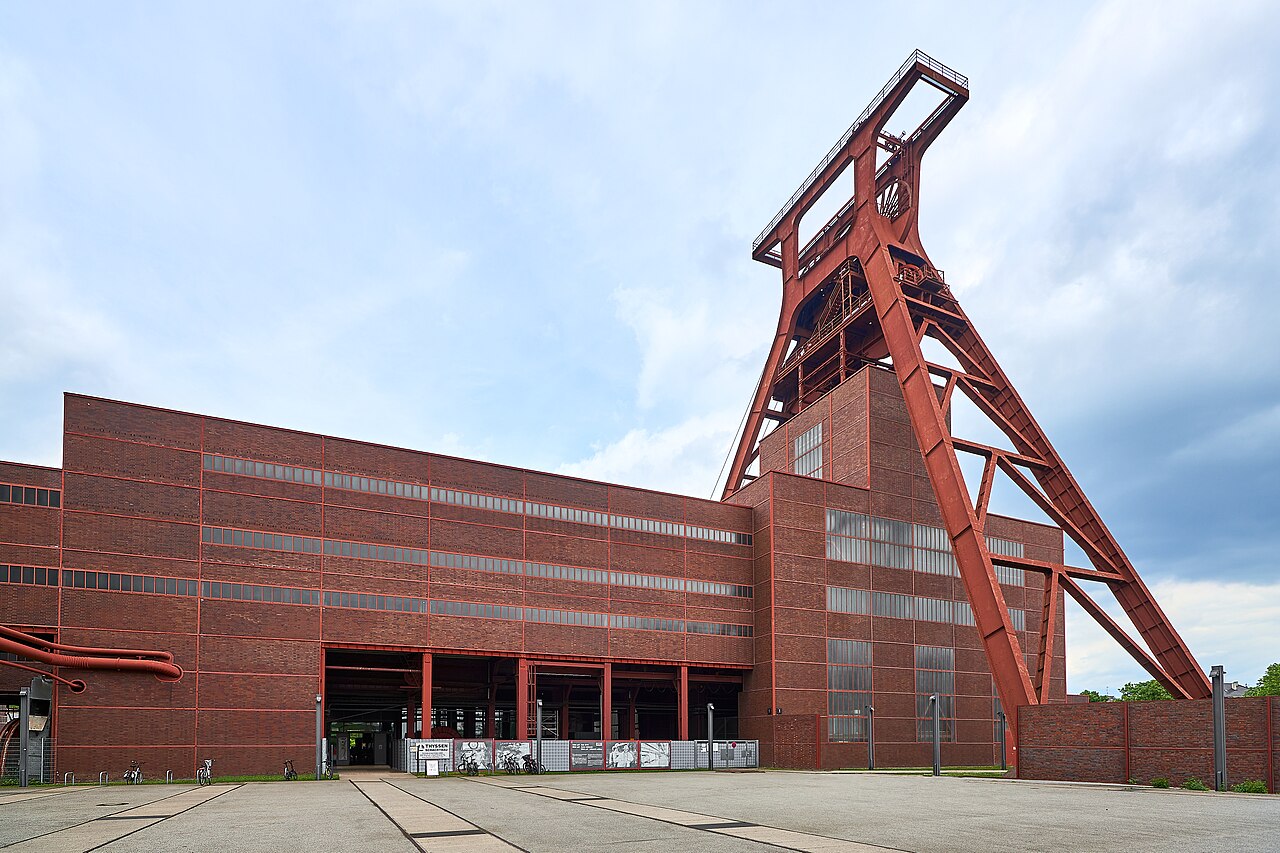
Essen grew up on coal, and coal is pure earth history. Around 300 million years ago, in the Carboniferous, this was a low coastal plain covered by vast swamp forests. Horsetails, giant clubmosses and ferns turned into peat over millions of years, and later deposits pressed that peat into hard coal. The seams, some finger-thin, some metres thick, run beneath the entire Ruhr district and have shaped the region like almost nothing else in Germany.
Mining marked Essen for nearly two centuries. The Zollverein colliery, now a World Heritage Site, was once called the most beautiful pit in the world, and its coking plant processed coal on an industrial scale. In 2018 the neighbouring Prosper-Haniel mine in Bottrop closed as the last hard-coal colliery in Germany, a date that ended a whole era. What remains are winding towers, spoil heaps and a dense web of old galleries underground.
For fossil hunters it is the waste rock that matters. The ironstone nodules and dark shales of the spoil heaps carry the imprints of Carboniferous plants: the ribbed trunks of Sigillaria, the scale patterns of Lepidodendron, whole fern fronds and the jointed stems of Calamites. More rarely, marine bands yield goniatites, the coiled forerunners of ammonites. It is seldom spectacular, but a clean fern impression from the Ruhr speaks directly of the forests the coal was made from. ORECAST shows the documented sites and exposures within reach.
Safety comes before everything here. Old adits and sudden sinkholes can kill, and abandoned workings can release mine gas, so such places are strictly off limits. Many spoil heaps are now green and open as parks, while others belong to the mining successor company and may not be entered. Turning over a loose lump of shale on an open heap harms no one; arriving with a spade is another matter. And as everywhere, private ground only with permission.
Minerals & raw materials near Essen (Ruhr)
Within 30 km of Essen (Ruhr) our database holds 2097 documented mineral and ore points. The most common commodities nearby:
Documented finds nearby
- GD NRW RK50 LG: Ton/SchluffTon/Schluff · source: GD NRW RK50 LG0 km
- BGR BSK1000: SteinkohleSteinkohle · source: BGR BSK10000 km
- Ruhrsandstein - Sandstein, meist fein- bis mittelkörnig, auch grobkörnig. Feldspat führend bis feldspatreich, oft mit kohligen Flittern. Die Bindung ist überwiegend kieselig oder tonig-kieselig, untergeordnet tonig oder karbonatisch. Stellenweise Korn-an-Korn-Bindung. (Eignung: Werkstein)Sandstein · source: GD NRW RK50 FG1.8 km
- GD NRW RK50 LG: Kies/KiessandKies/Kiessand · source: GD NRW RK50 LG1.9 km
- Ruhrsandstein - Sandstein, meist fein- bis mittelkörnig, auch grobkörnig. Feldspat führend bis feldspatreich, oft mit kohligen Flittern. Die Bindung ist überwiegend kieselig oder tonig-kieselig, untergeordnet tonig oder karbonatisch. Stellenweise Korn-an-Korn-Bindung. (Eignung: Werkstein)Sandstein · source: GD NRW RK50 FG2 km
- Ruhrsandstein - Sandstein, meist fein- bis mittelkörnig, auch grobkörnig. Feldspat führend bis feldspatreich, oft mit kohligen Flittern. Die Bindung ist überwiegend kieselig oder tonig-kieselig, untergeordnet tonig oder karbonatisch. Stellenweise Korn-an-Korn-Bindung. (Eignung: Werkstein)Sandstein · source: GD NRW RK50 FG2 km
- GD NRW RK50 LG: Kies/KiessandKies/Kiessand · source: GD NRW RK50 LG2.2 km
- GD NRW RK50 LG: Kies/KiessandKies/Kiessand · source: GD NRW RK50 LG2.3 km
- Ruhrsandstein - Sandstein, meist fein- bis mittelkörnig, auch grobkörnig. Feldspat führend bis feldspatreich, oft mit kohligen Flittern. Die Bindung ist überwiegend kieselig oder tonig-kieselig, untergeordnet tonig oder karbonatisch. Stellenweise Korn-an-Korn-Bindung. (Eignung: Werkstein)Sandstein · source: GD NRW RK50 FG2.6 km
- Ruhrsandstein - Sandstein, meist fein- bis mittelkörnig, auch grobkörnig. Feldspat führend bis feldspatreich, oft mit kohligen Flittern. Die Bindung ist überwiegend kieselig oder tonig-kieselig, untergeordnet tonig oder karbonatisch. Stellenweise Korn-an-Korn-Bindung. (Eignung: Werkstein)Sandstein · source: GD NRW RK50 FG2.6 km
- Ruhrsandstein - Sandstein, meist fein- bis mittelkörnig, auch grobkörnig. Feldspat führend bis feldspatreich, oft mit kohligen Flittern. Die Bindung ist überwiegend kieselig oder tonig-kieselig, untergeordnet tonig oder karbonatisch. Stellenweise Korn-an-Korn-Bindung. (Eignung: Werkstein)Sandstein · source: GD NRW RK50 FG2.6 km
- Ruhrsandstein - Sandstein, meist fein- bis mittelkörnig, auch grobkörnig. Feldspat führend bis feldspatreich, oft mit kohligen Flittern. Die Bindung ist überwiegend kieselig oder tonig-kieselig, untergeordnet tonig oder karbonatisch. Stellenweise Korn-an-Korn-Bindung. (Eignung: Werkstein)Sandstein · source: GD NRW RK50 FG2.6 km
- Ruhrsandstein - Sandstein, meist fein- bis mittelkörnig, auch grobkörnig. Feldspat führend bis feldspatreich, oft mit kohligen Flittern. Die Bindung ist überwiegend kieselig oder tonig-kieselig, untergeordnet tonig oder karbonatisch. Stellenweise Korn-an-Korn-Bindung. (Eignung: Werkstein)Sandstein · source: GD NRW RK50 FG2.8 km
- Ruhrsandstein - Sandstein, meist fein- bis mittelkörnig, auch grobkörnig. Feldspat führend bis feldspatreich, oft mit kohligen Flittern. Die Bindung ist überwiegend kieselig oder tonig-kieselig, untergeordnet tonig oder karbonatisch. Stellenweise Korn-an-Korn-Bindung. (Eignung: Werkstein)Sandstein · source: GD NRW RK50 FG2.9 km
What the ground is made of
Official soil maps cover 65 % of the area within the radius. Each list names its source and refers to the part of that area the source describes. Where layers overlap, shares can add up to more than 100 %.
Material
Source: GD NRW RK50 LG.
Fossils near Essen (Ruhr)
- Essen GreensandCenomanian · source: PBDB0.3 km
- Essen-Gildehofplatz (Mittelcenoman)Middle Cenomanian · Essener Grünsand · source: PBDB0.6 km
- Munsterland Basin NW GermanyEarly Campanian · source: PBDB2.8 km
- Essen (Mittelcenoman)Middle Cenomanian · Essener Grünsand · source: PBDB3.7 km
- Essen-on-the-Ruhr (BMNH collection)Hauterivian · source: PBDB3.8 km
- Zeche Wolfsbank, Röttgersbank seamWestphalian A · Bochum · source: PBDB4 km
- Johann Wakker gravel pitLate Pleistocene · source: PBDB9.4 km
- Hauptfloez seam, St. Hubertus mineNamurian · Sprockhoeveler · source: PBDB9.6 km
- Gladbeck-Beckhausen (unteres Mittelsanton)Middle Santonian · source: PBDB11 km
- Gladbeck-Beckhausen (Mittelsanton)Middle Santonian · source: PBDB11 km
History & archaeology near Essen (Ruhr)
- Silberkuhlsturmarchaeological3.7 km
- Sommerburgarchaeological4 km
- Schloß Schellenbergcastle_monument4.7 km
- Burgruine Vittinghoffarchaeological4.9 km
- Schloss Borbeckcastle_monument5 km
- Schloss Borbeckcastle_monument5 km
- Neue Isenburg / Essen - Burgruinearchaeological5.3 km
- Burgruine Neue Isenburgcastle_monument5.4 km
- Schloss Baldeneycastle_monument5.5 km
- Haus Horlarchaeological6 km
Treasure hunting, law & safety
We'd rather underclaim than oversell: a promising geology is no guarantee, and you won't find invented numbers here. Digging and collecting are regulated across Europe and usually need a permit, and protected monuments and nature reserves are off-limits.
Frequently asked questions
Can I dig or collect finds near Essen (Ruhr)?
Digging and collecting finds are regulated in most of Europe and usually need a permit; protected monuments and nature reserves are off-limits. ORECAST shows where protected/historical sites lie so you can check the local rules first. It is information, not a permit.
Where can I find gold near Essen (Ruhr)?
Around Essen (Ruhr), gold is at most plausible as river placer (hobby-scale panning), not a documented deposit unless flagged on the map. ORECAST clearly separates documented finds from merely plausible geology, and it never promises gold.
What minerals and raw materials occur near Essen (Ruhr)?
Within 30 km we list 2097 documented mineral/ore points. The most common nearby are: Sandstein, Karbonatgestein, Kies/Kiessand, Ton/Schluff, Sand.
Are there fossils near Essen (Ruhr)?
Yes, 120 scientific fossil localities are recorded within 30 km (with geological age and formation).
Is digging dangerous near Essen (Ruhr)?
Possibly: former war zones can hold unexploded ordnance. Where a site is flagged with the ☢️ warning, never dig, it is a danger to life; contact the bomb-disposal service if in doubt.
Identify & compare:
Identify fossils · Identify rocks & minerals · Find gold · Find silver · Find gemstones · App comparison
Explore other regions:
the Ruhr · Cologne · Bonn · Aachen · Siegen (Siegerland) · Maastricht