 orecast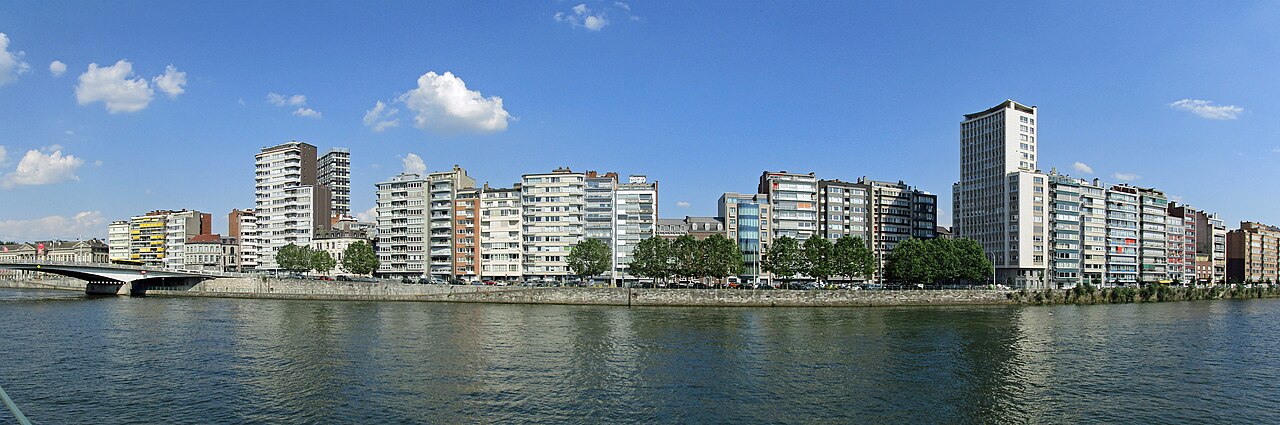
Liège, Lüttich in German, stands on the Meuse in the heart of an old coal country. The hard-coal seams of the Walloon basin run beneath the city, formed in the Carboniferous some 310 million years ago from the swamp forests of a tropical coastal plain. For centuries Liège lived off coal mining and the iron and weapons industry it fed, until the last pits closed in the 1980s.
Beneath the coal lies an older, harder rock: the limestone of the Devonian and early Carboniferous. From it Belgians still cut the petit granit, a dark limestone shot through with the stems of sea lilies, sold as bluestone for the stairs, sills and church doorways of half the country and beyond. These same beds are the real prize for fossil hunters. In the quarries and hillsides of the Meuse valley and the northern Ardennes sit crinoids, brachiopods, corals and the net-like colonies of bryozoans, witnesses of a warm Devonian sea.
Anyone looking today finds more industrial heritage than open pits. The visitor mine at Blegny, northeast of the city, descends into genuine coal galleries and counts among the recognised Walloon mining sites. Disused limestone quarries and stream cuts in the Ardennes expose the Devonian fossils, and the Meuse carries pebbles from its whole catchment in its gravel. Spectacular single pieces are rare, but a clean brachiopod shell from Belgian limestone is an honest find. ORECAST shows the documented sites within reach.
Caution is in order for both law and safety. Old coal galleries and sudden sinkholes in the district can kill, and many mine fields are sealed off. Limestone quarries are private ground and need permission. Belgium has its own collecting law, and cross the nearby German or Dutch border and you are at once under different rules. The Meuse, finally, is a big river, and its banks are no place for carelessness.
Minerals & raw materials near Liège
Within 30 km of Liège our database holds 9447 documented mineral and ore points. The most common commodities nearby:
Documented finds nearby
- FerEisen · source: SPW - Minéralisations Wallonie10 km
- FerEisen · source: SPW - Minéralisations Wallonie10.6 km
- Bohrung kb41-B9Lehm (Bohrung) · source: DOV - Bohrungen Flandern13.5 km
- Bohrung BGD107W0284Lehm (Bohrung) · source: DOV - Bohrungen Flandern13.5 km
- PlombBlei · source: SPW - Minéralisations Wallonie13.6 km
- ZincZink · source: SPW - Minéralisations Wallonie13.7 km
- Bohrung kb34d107w-B19Lehm (Bohrung) · source: DOV - Bohrungen Flandern13.7 km
- Bohrung kb33d106e-B645Lehm (Bohrung) · source: DOV - Bohrungen Flandern14 km
- Bohrung kb33d106e-B647Lehm (Bohrung) · source: DOV - Bohrungen Flandern14 km
- Bohrung kb33d106e-B646Lehm (Bohrung) · source: DOV - Bohrungen Flandern14 km
- Bohrung B/901/82/5Lehm (Bohrung) · source: DOV - Bohrungen Flandern14.1 km
- Bohrung kb34d107w-B304Lehm (Bohrung) · source: DOV - Bohrungen Flandern14.1 km
- Bohrung kb34d107w-B307Lehm (Bohrung) · source: DOV - Bohrungen Flandern14.1 km
- Bohrung kb33d106e-B767Lehm (Bohrung) · source: DOV - Bohrungen Flandern14.1 km
Fossils near Liège
- Sart-tilman, near stream BLanc GravierEarly Devonian · source: PBDB0 km
- Ensival outcrop, BelgiumDevonian · Acoz · source: PBDB0 km
- Palaedaphus type-locality (nominal)Frasnian · source: PBDB0.4 km
- Bonne-Fin coal mine, roof of Dure-VeineWestphalian B · source: PBDB1.7 km
- Saint-NicolasPliocene · source: PBDB2.1 km
- CPL SA-Haccourt quarryLate Maastrichtian · Gulpen · source: PBDB2.1 km
- Angleur Outcrop, Ourthe ValleyLate Famennian · Evieux · source: PBDB3 km
- Phosphates de Roccourt, LiègeEarly Maastrichtian · source: PBDB4.7 km
- ChèvremontFamennian · Montfort / Evieux · source: PBDB5.9 km
- Fond-des-Cris - BryozoaLate Frasnian · Lambermont · source: PBDB6 km
History & archaeology near Liège
- Hôtel des Comtes de Méancastle_monument1.3 km
- Van der Valk Hotel Liège Sélyscastle_monument1.3 km
- Le Castelcastle_monument1.4 km
- Maison De Francquencastle_monument1.5 km
- Palais des Princes-Évèquescastle_monument1.5 km
- Palais de Justice de Liègecastle_monument1.6 km
- Château Mayettecastle_monument1.7 km
- Hôtel de Gradycastle_monument1.7 km
- Arvô de la Chartreusecastle_monument1.9 km
- Maison Curtiuscastle_monument2 km
Treasure hunting, law & safety
We'd rather underclaim than oversell: a promising geology is no guarantee, and you won't find invented numbers here. Digging and collecting are regulated across Europe and usually need a permit, and protected monuments and nature reserves are off-limits.
Frequently asked questions
Can I dig or collect finds near Liège?
Digging and collecting finds are regulated in most of Europe and usually need a permit; protected monuments and nature reserves are off-limits. ORECAST shows where protected/historical sites lie so you can check the local rules first. It is information, not a permit.
Where can I find gold near Liège?
Around Liège, gold is at most plausible as river placer (hobby-scale panning), not a documented deposit unless flagged on the map. ORECAST clearly separates documented finds from merely plausible geology, and it never promises gold.
What minerals and raw materials occur near Liège?
Within 30 km we list 9447 documented mineral/ore points. The most common nearby are: Ton (Bohrung), Lehm (Bohrung), Kies (Bohrung), Sand (Bohrung), Zink.
Are there fossils near Liège?
Yes, 1325 scientific fossil localities are recorded within 30 km (with geological age and formation).
Is digging dangerous near Liège?
Possibly: former war zones can hold unexploded ordnance. Where a site is flagged with the ☢️ warning, never dig, it is a danger to life; contact the bomb-disposal service if in doubt.
Identify & compare:
Identify fossils · Identify rocks & minerals · Find gold · Find silver · Find gemstones · App comparison
Explore other regions:
Maastricht · Aachen · Brussels · Antwerp · Trier · Cologne