 orecast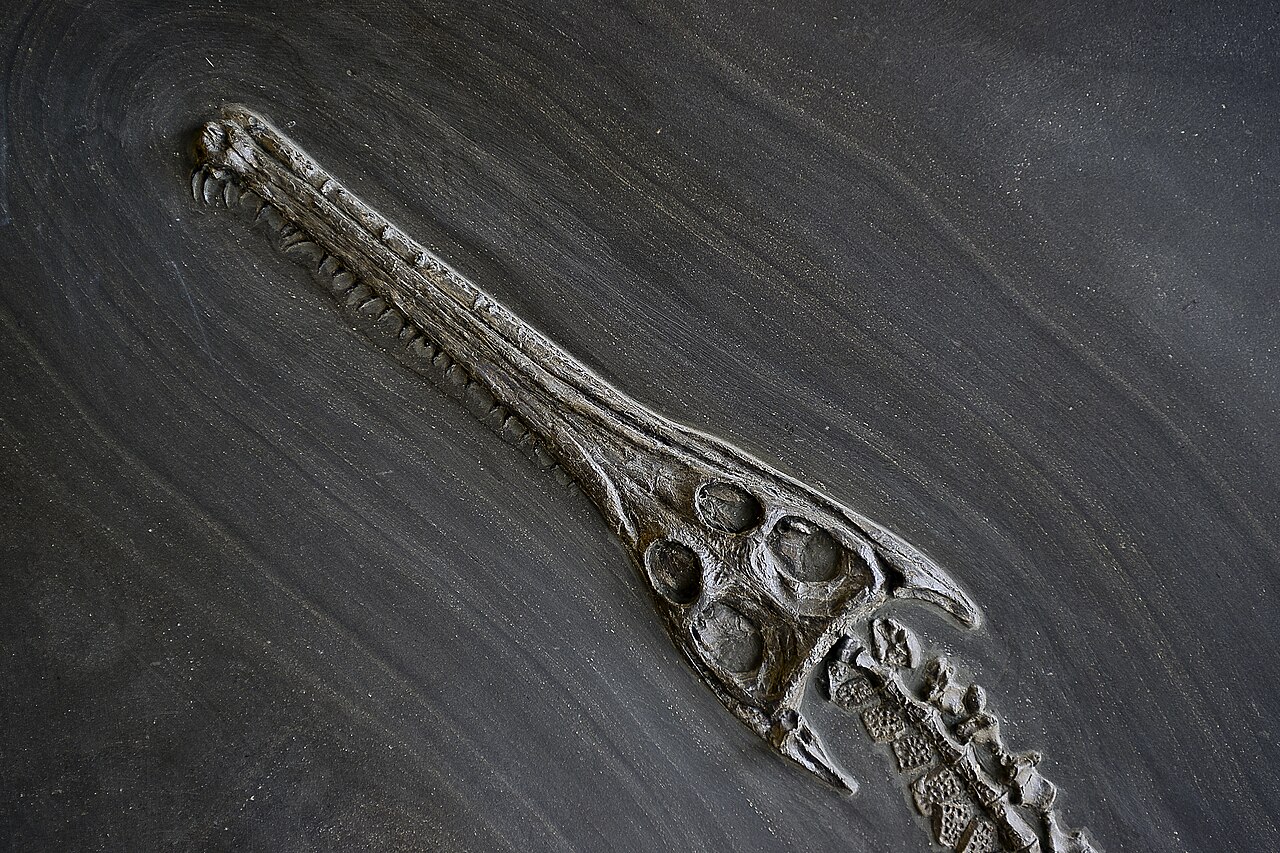
Holzmaden, a village below the escarpment of the Swabian Alb southeast of Stuttgart, sits on the Posidonia Shale, a finely laminated oil shale from the Early Jurassic, around 180 million years old. A tropical sea covered southern Germany then, and its stagnant, oxygen-starved bottom waters preserved whatever sank to the sea floor in remarkable completeness: ichthyosaurs with the outline of their skin intact, marine crocodiles, pterosaurs and crinoid colonies many metres across.
One family made the rock famous. Bernhard Hauff began extracting and preparing the fossils in the late 19th century, turning preparation into a craft in its own right, and slabs from his workshop ended up in museums from Stuttgart to New York. The Urweltmuseum Hauff in Holzmaden still shows the results, among them a fossil crinoid colony of roughly 100 square metres, one of the largest display fossils anywhere.
You can dig here yourself, in an orderly fashion. A few shale quarries around Holzmaden and Ohmden open designated splitting areas to visitors for a fee, often with tools for hire. Realistic finds are ammonites such as Dactylioceras, belemnites, bivalves and fish remains; an ichthyosaur bone is a genuine exception. The shale splits cleanly, so a broad chisel and patience go a long way. ORECAST maps the documented localities in the area and what has been described at each of them.
One rule stands above all the others: the ground around Holzmaden is a legally protected excavation area under German heritage law. Digging is allowed only at the released sites, and unofficial collecting in road cuttings or abandoned quarries is an offence. Scientifically important finds must be reported, because the state of Baden-Württemberg treats them as cultural heritage. The rules protect exactly what draws people here in the first place.
Minerals & raw materials near Holzmaden
Within 25 km of Holzmaden our database holds 249 documented mineral and ore points. The most common commodities nearby:
Documented finds nearby
- BGR BSK1000: ÖlschieferÖlschiefer · source: BGR BSK10000 km
- zwischen Holzmaden und AichelbergNaturwerksteine - prognostiziert · prognostiziert · depth KMR50 L 7322-RV2.2, Bearbeitung 2008 · source: LGRB BW - Rohstoffvorkommen KMR500 km
- ostnordöstlich HolzmadenNaturwerksteine - nachgewiesen · nachgewiesen · depth KMR50 L 7322-RV2.1, Bearbeitung 2008 · source: LGRB BW - Rohstoffvorkommen KMR500.7 km
- östlich HolzmadenNaturwerksteine - nachgewiesen · nachgewiesen · depth KMR50 L 7322-RV2.3, Bearbeitung 2008 · source: LGRB BW - Rohstoffvorkommen KMR500.9 km
- zwischen Schlierbach, Ohmden und Zell unter AichelbergNaturwerksteine - prognostiziert · prognostiziert · depth KMR50 L 7322-RV1.4, Bearbeitung 2008 · source: LGRB BW - Rohstoffvorkommen KMR501.4 km
- 1 km nordöstlich OhmdenNaturwerksteine - nachgewiesen · nachgewiesen · depth KMR50 L 7322-RV1.2, Bearbeitung 2008 · source: LGRB BW - Rohstoffvorkommen KMR502.1 km
- ca. 1,5 km südsüdöstlich SchlierbachNaturwerksteine - nachgewiesen · nachgewiesen · depth KMR50 L 7322-RV1.1, Bearbeitung 2008 · source: LGRB BW - Rohstoffvorkommen KMR502.5 km
- BGR BSK1000: Ton, TonsteinTon, Tonstein · source: BGR BSK10002.7 km
- 1 km westlich Zell unter AichelbergNaturwerksteine - nachgewiesen · nachgewiesen · depth KMR50 L 7322-RV1.3, Bearbeitung 2008 · source: LGRB BW - Rohstoffvorkommen KMR503.1 km
- Salzgesteine, fraglichSalzgesteine, fraglich · fraglich · depth unter Tage, zwischen Bohrungen interpoliert · source: LGRB BW - Rohstoffvorkommen unter Tage4.6 km
- BGR BSK1000: Kalkstein und DolomitsteinKalkstein und Dolomitstein · source: BGR BSK10006.3 km
- nordöstlich BollÖlschiefer - nachgewiesen · nachgewiesen · depth KMR50 L 7322-RV3, Bearbeitung 2008 · source: LGRB BW - Rohstoffvorkommen KMR506.6 km
- BGR BSK1000: Ton, TonsteinTon, Tonstein · source: BGR BSK10006.8 km
- BGR BSK1000: Kalkstein und DolomitsteinKalkstein und Dolomitstein · source: BGR BSK10007.5 km
Fossils near Holzmaden
- near Hauff Quarry XXVIII, HolzmadenEarly Toarcian · Posidonia Shale · source: PBDB0.5 km
- Holzmaden, epsilon II/4 (SMNS collection)Falciferum · Posidonienschiefer · source: PBDB0.6 km
- Holzmaden, NHM specimen, epsilon II/4?Early Toarcian · Posidonia Shale · source: PBDB0.6 km
- Holzmaden, epsilon II/3, Uppsala pterosaurEarly Toarcian · Posidonia Shale · source: PBDB0.6 km
- Hauff Quarry XIV, HolzmadenEarly Toarcian · Posidonia Shale · source: PBDB0.6 km
- Hauff Quarry IX, Holzmaden, epsilon II/4Early Toarcian · Posidonia Shale · source: PBDB0.6 km
- Hauff Quarry IX, Holzmaden, epsilon II/6Early Toarcian · Posidonia Shale · source: PBDB0.6 km
- Holzmaden, Quarry 29 (=Steinbruch 29), Ohmden; Lias epsilon II, 4Falciferum · Posidonia Shale · source: PBDB0.6 km
- Holzmaden, Univ Löwen, epsilon II/3Early Toarcian · Posidonia Shale · source: PBDB0.6 km
- Hauff Quarry I, HolzmadenEarly Toarcian · Posidonia Shale · source: PBDB0.6 km
History & archaeology near Holzmaden
- Reste de "Natter"-Startrampe Ablagearchaeological2.1 km
- Bachem Natter Startrampe 3archaeological2.1 km
- Burg Aichelbergarchaeological3.4 km
- Burg Limburgarchaeological3.5 km
- ehemalige Burg Lichtensteincastle_monument5.4 km
- Ruine Hahnenkammcastle_monument5.6 km
- Kirchheimer Schlosscastle_monument5.7 km
- ehemalige Burg Lichteneckcastle_monument6.2 km
- ehemalige Burg Erkenbergcastle_monument6.4 km
- Burgstelle Randeckcastle_monument6.5 km
Treasure hunting, law & safety
We'd rather underclaim than oversell: a promising geology is no guarantee, and you won't find invented numbers here. Digging and collecting are regulated across Europe and usually need a permit, and protected monuments and nature reserves are off-limits.
Frequently asked questions
Can I dig or collect finds near Holzmaden?
Digging and collecting finds are regulated in most of Europe and usually need a permit; protected monuments and nature reserves are off-limits. ORECAST shows where protected/historical sites lie so you can check the local rules first. It is information, not a permit.
Where can I find gold near Holzmaden?
Around Holzmaden, gold is at most plausible as river placer (hobby-scale panning), not a documented deposit unless flagged on the map. ORECAST clearly separates documented finds from merely plausible geology, and it never promises gold.
What minerals and raw materials occur near Holzmaden?
Within 25 km we list 249 documented mineral/ore points. The most common nearby are: Natursteine: Karbonatgesteine, Natursteine (Kalksteine) - nachgewiesen, Naturwerksteine, Ziegeleirohstoffe, Zementrohstoffe.
Are there fossils near Holzmaden?
Yes, 211 scientific fossil localities are recorded within 25 km (with geological age and formation).
Is digging dangerous near Holzmaden?
Possibly: former war zones can hold unexploded ordnance. Where a site is flagged with the ☢️ warning, never dig, it is a danger to life; contact the bomb-disposal service if in doubt.
Identify & compare:
Identify fossils · Identify rocks & minerals · Find gold · Find silver · Find gemstones · App comparison
Explore other regions:
Stuttgart · Solnhofen/Eichstätt · Frankfurt · Nuremberg · Freiburg (Black Forest) · Munich