 orecast
Germany · Switzerland · Austria · France · Belgium · Netherlands · Italy · Sweden · Finland · Ireland · Czechia · Poland
Germany
Collecting (minerals/fossils): Collecting minerals and fossils is not a heritage matter, but: ask the landowner, nature reserves and national parks are off-limits, active quarries only with the operator. Never enter old adits.
Metal detecting: Heritage law is state law. Targeted searching for archaeological objects (including with a detector) needs a state heritage-office permit (NFG) almost everywhere; every state has a treasure-trove rule, most of them only for certain finds (state excavations, protected areas, unauthorised searching, outstanding scientific value); comprehensive in Bavaria (since 2023), North Rhine-Westphalia, Saxony, Berlin and Hamburg. Suspected ordnance: leave it, call EOD.
Gold panning: Hobby-scale gold panning (pan, no machines) is broadly tolerated on the known rivers; riverbank access, nature-protection and fishery rules still apply. Commercial extraction is mining law.
Germany, state by state (metal detecting / NFG)
- Baden-WürttembergTargeted searching needs a heritage-office permit (NFG); treasure trove goes to the state.
- BayernNo general search permit, but a treasure-trove rule since 1 July 2023 (Art. 9 BayDSchG): archaeological finds become state property on discovery and must be handed to the State Office; the finder gets a reward under § 971 BGB. Detectors are banned on registered monuments (Art. 7 para. 7), digging on suspected sites needs a permit (Art. 7 para. 1), every find must be reported (Art. 8). The 50/50 split applies only to finds made before 1 July 2023.
- BerlinExcavation/search permit required; treasure trove applies.
- BrandenburgNFG permit required; treasure trove applies.
- BremenNFG permit required; treasure trove applies.
- HamburgNFG permit required; treasure trove applies.
- HessenNFG permit required; treasure trove applies.
- Mecklenburg-VorpommernNFG permit required (training course customary); treasure trove applies.
- NiedersachsenNFG permit required; treasure trove applies.
- Nordrhein-WestfalenNFG permit required; treasure trove applies.
- Rheinland-PfalzNFG permit required; treasure trove applies.
- SaarlandNFG permit required; treasure trove applies.
- SachsenNFG permit required; treasure trove applies; note the extensive protected-excavation zones.
- Sachsen-AnhaltNFG permit required; treasure trove applies.
- Schleswig-HolsteinStrictest state: any detector search needs a permit, violations are punishable; treasure trove applies.
- ThüringenNFG permit required; treasure trove applies.
Switzerland
Collecting (minerals/fossils): Crystal hunting (Strahlen) is cantonal, from free collecting to patent requirements (parts of Uri, Valais, Graubünden). The National Park and reserves are off-limits; clefts are alpine terrain.
Metal detecting: Searching for archaeological objects with a detector needs cantonal authorisation; finds must be reported.
Gold panning: Hobby gold panning is common and mostly permitted under cantonal/communal rules (no machines, no bank digging). Local clubs know the customs.
Austria
Collecting (minerals/fossils): Collect with the landowner's consent; national parks and reserves are off-limits; some alpine cleft areas are club-managed.
Metal detecting: Searching for archaeological objects (including with a detector) requires a Federal Monuments Office permit; finds must be reported.
Gold panning: Gold panning is an established visitor activity in classic districts (e.g. Rauris); elsewhere ask the landowner and follow local rules.
France
Collecting (minerals/fossils): Collecting on private land only with permission; national parks and reserves ban removal; many classic sites are protected.
Metal detecting: Detector searching for objects of historical interest is forbidden without official authorisation (Code du patrimoine), and that is taken seriously.
Gold panning: Gold panning requires declaration/authorisation in several departments (classic Cévennes/Pyrenees rivers); clubs help with the paperwork.
Belgium
Collecting (minerals/fossils): Collect with the owner's or operator's permission; Ardennes quarries are private.
Metal detecting: Flanders runs a recognition system for metal detectorists (licence + rules); Wallonia is more restrictive and permit-based.
Gold panning: No notable gold-panning ground; streams fall under general water and nature rules.
Netherlands
Collecting (minerals/fossils): Little rock, much ownership: collecting (e.g. glacial erratics at pits) with the owner's/operator's permission.
Metal detecting: Metal detecting has been broadly legal since 2016, except on monuments and excavations; finds should be reported (PAN). Municipalities may add rules.
Gold panning: Not a gold country; beaches and magnet fishing follow municipal rules.
Italy
Collecting (minerals/fossils): Strict: cultural objects belong to the State; several regions also restrict mineral and fossil removal (Elba!). Check regional rules first.
Metal detecting: Detector searching for antiquities is effectively banned or strictly permit-bound; several regions ban detectors outright.
Gold panning: Historic gold rivers (Piedmont) have local panning traditions and clubs; outside organised ground, hold back and ask locally.
Sweden
Collecting (minerals/fossils): The right to roam does NOT cover stones: hammering or taking needs the landowner's consent; protected areas are off-limits.
Metal detecting: Very strict: using metal detectors is generally banned and allowed only with a county-board (Länsstyrelse) permit per area.
Gold panning: Hobby panning works at established sites (e.g. Ädelfors); mineral rights are state-administered via Bergsstaten.
Finland
Collecting (minerals/fossils): Everyman's rights exclude digging/hammering; taking minerals needs the landowner (state land: the forest administration).
Metal detecting: Detecting is allowed, but ancient finds are automatically protected and must be reported; digging at find spots is forbidden.
Gold panning: Gold panning on state land needs a licence; national parks have special rules and machines are history.
Ireland
Collecting (minerals/fossils): Collect with the landowner's permission; protected geosites (e.g. the Valentia trackway) are untouchable.
Metal detecting: Europe's strictest regime: detector searching for archaeological objects without state consent is a criminal offence; finds belong to the State.
Gold panning: River gold belongs to the State; hobby panning at flitter scale is tolerated, nothing more.
Czechia
Collecting (minerals/fossils): Surface collecting of common minerals is broadly tolerated outside protected areas; digging needs the owner. Moldavite fields are policed because of illegal pits.
Metal detecting: Archaeological finds belong to the public authorities; detector searching for archaeology is illegal without working under an archaeological organisation.
Gold panning: No classic panning ground; historic placers (Otava) with restraint and the owner's consent.
Poland
Collecting (minerals/fossils): Collect with the owner's permission, active quarries only with the operator. Beach-picking amber is free and legal.
Metal detecting: Liberalised since May 2024: registration (app) instead of a permit on ordinary ground; monuments and their surroundings stay off-limits, archaeological finds belong to the State.
Gold panning: Traditional ground in Lower Silesia (Złotoryja) with organised events; elsewhere respect owners and water law.
⚠️ Wichtiger Hinweis
This page is a curated summary, dated as shown, and NOT legal advice. Protected areas and monuments are always off-limits, old mine workings are deadly, and suspected ordnance means: leave it and call EOD. When in doubt, the authority in charge decides.
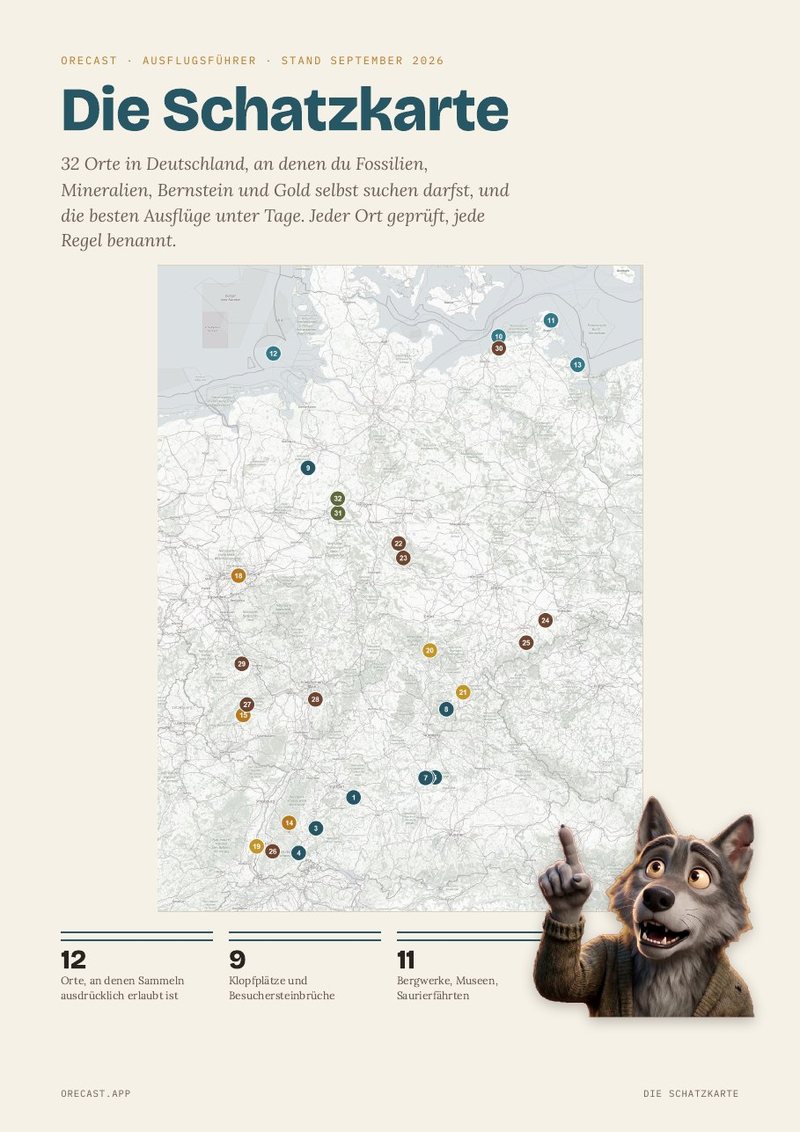
32 geprüfte Orte mit Ampel: An zwölf darfst du selbst sammeln, an sieben mit Regeln, dreizehn sind zum Anschauen. Mit Steckbrief, Werkzeug und Quelle je Ort. PDF, 33 Seiten, 12,90 €.
Zur Schatzkarte
Kostenlose Vorlagen: Such- und Sammelerlaubnis / Free permission templates