 orecast
Agate & gemstones in Idar-Oberstein
Can you find agate and gemstones in Idar-Oberstein? This is Germany's gemstone town. Agates grew in the cavities of Permian lava here, and at the Steinkaulenberg you can dig for them yourself.
Open the map for this region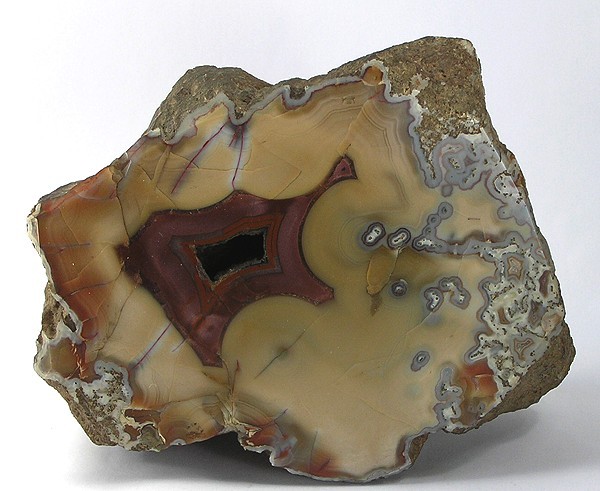
Idar-Oberstein is Germany's gemstone town, and for good reason. In the Permian, volcanism broke through here, and over millions of years agates and rock crystal grew in the cavities of the cooled lava. From the fifteenth century miners took these stones out of the Hunsrück hills, and a whole cutting industry grew up along the Nahe, driven by the water of its streams. orecast shows the documented occurrences and the many mining sites nearby.
When the local agate veins ran out in the nineteenth century, cutters from Oberstein emigrated to Brazil and found huge agate deposits in Rio Grande do Sul. From then on the rough came by ship while the craft of cutting stayed on the Nahe. That link still shapes the town, whose dealers and museums are among the first addresses in the trade.
You can search yourself at the Steinkaulenberg, the only gemstone show mine in Europe. Inside, the old galleries run through agate-bearing rock, and on the attached digging field you may search for agate, amethyst and rock crystal for a fee and keep your finds. What fine rough becomes is on show at the German Gemstone Museum and at the historic Weiherschleife, where a water-powered grinding wheel still turns as it did two hundred years ago.
Do not expect a museum piece on your first afternoon. The fine banded agates are a matter of luck, and most finds are palm-sized lumps that only reveal their pattern once they are cut. That is the appeal: the cut shows what the stone was hiding. On the supervised digging field everything is arranged. On private fields and in the quarries around town nothing goes without the owner's permission, and working quarries are dangerous.
Key
- documented mineral & ore points
- 102
- fossil sites
- 148
- historical sites
- 1358
801 sites within 40 km are flagged as war or WWII sites with possible unexploded ordnance. Never dig there, it is a danger to life.
Documented finds nearby
- BGR BSK1000: Vulkanische FestgesteineVulkanische Festgesteine · source: BGR BSK10000 km
- Andesitsteinbruch Niederwoerresbachoberflächennaher Rohstoff · Abbau in der Fläche (nachgewiesene Bauwürdigkeit), LGB-Kategorie 1a · source: LGB RLP - Rohstoffsicherung, Abbauflächen (Kat. 1a/1b)6 km
- Niederwörresbachoberflächennaher Rohstoff · Abbau in der Fläche (nachgewiesene Bauwürdigkeit), LGB-Kategorie 1a · source: LGB RLP - Rohstoffsicherung, Abbauflächen (Kat. 1a/1b)6.5 km
- Berschweileroberflächennaher Rohstoff · Abbau mindestens in einem Teilbereich (nachgewiesene Bauwürdigkeit), LGB-Kategorie 1b · source: LGB RLP - Rohstoffsicherung, Abbauflächen (Kat. 1a/1b)7.9 km
- Berschweileroberflächennaher Rohstoff · Abbau mindestens in einem Teilbereich (nachgewiesene Bauwürdigkeit), LGB-Kategorie 1b · source: LGB RLP - Rohstoffsicherung, Abbauflächen (Kat. 1a/1b)8.3 km
- BGR BSK1000: QuarzitQuarzit · source: BGR BSK10008.8 km
- BGR BSK1000: SchieferSchiefer · source: BGR BSK10009.2 km
- Hubertusruhoberflächennaher Rohstoff · Abbau in der Fläche (nachgewiesene Bauwürdigkeit), LGB-Kategorie 1a · source: LGB RLP - Rohstoffsicherung, Abbauflächen (Kat. 1a/1b)9.8 km
- Saar/NaheFeldspat · in Betrieb (Stand GK2000, 2004) · source: BGR GK2000 - Lagerstätten9.8 km
- Huberusruhoberflächennaher Rohstoff · Abbau in der Fläche (nachgewiesene Bauwürdigkeit), LGB-Kategorie 1a · source: LGB RLP - Rohstoffsicherung, Abbauflächen (Kat. 1a/1b)9.9 km
- Gollenbergoberflächennaher Rohstoff · Abbau mindestens in einem Teilbereich (nachgewiesene Bauwürdigkeit), LGB-Kategorie 1b · source: LGB RLP - Rohstoffsicherung, Abbauflächen (Kat. 1a/1b)10.6 km
- Gollenbergoberflächennaher Rohstoff · Abbau mindestens in einem Teilbereich (nachgewiesene Bauwürdigkeit), LGB-Kategorie 1b · source: LGB RLP - Rohstoffsicherung, Abbauflächen (Kat. 1a/1b)10.7 km
- Gollenbergoberflächennaher Rohstoff · Abbau mindestens in einem Teilbereich (nachgewiesene Bauwürdigkeit), LGB-Kategorie 1b · source: LGB RLP - Rohstoffsicherung, Abbauflächen (Kat. 1a/1b)11 km
- Ellenbergoberflächennaher Rohstoff · Abbau in der Fläche (nachgewiesene Bauwürdigkeit), LGB-Kategorie 1a · source: LGB RLP - Rohstoffsicherung, Abbauflächen (Kat. 1a/1b)11.7 km
Fossil sites nearby
- Algenrodt near Oberstein-NaheAsselian · Lebacher Schichten · source: PBDB1.4 km
- mine Camphausen near Fischbach Westphalian C · Untere Saarbrücker Schichten · source: PBDB6.6 km
- Schieleberg Quarry, HerrsteinEarly Emsian · Hunsrück Slate · source: PBDB7 km
- BerschweilerAsselian · Meisenheim · source: PBDB9.4 km
- Schieleberg Quarry, middle Kaub FormationEarly Emsian · middle Kaub · source: PBDB10.2 km
- BirkenfeldAsselian · source: PBDB12.5 km
- Schwarzenbach in BirkenfeldAsselian · source: PBDB12.5 km
- Feckweiler near Birkenfeld-NaheAsselian · Lebacher Schichten · source: PBDB13.2 km
- RathsweilerAutunian · Meisenheim · source: PBDB14.9 km
- Eschenbach-Bocksberg mine, BundenbachEarly Emsian · Hunsrück Slate · source: PBDB15.3 km
Collecting, law & safety
A promising geology is never a guarantee, and you will not find invented numbers here. Collecting and digging are regulated across Europe and usually need a permit. Protected sites, nature reserves and disused mines are off-limits and can be deadly.
Frequently asked questions
Can you dig for gemstones in Idar-Oberstein yourself?
Yes, the Steinkaulenberg has a digging field where visitors search for agate, amethyst and rock crystal for a fee and keep what they find. It is the easiest and legal way. Collecting on private land needs the owner's permission.
Why is Idar-Oberstein famous for gemstones?
In the Permian, agates and rock crystal formed in the local volcanic rocks, mined from the fifteenth century and cut along the Nahe. When the local supply ran out, rough came from Brazil while the cutting craft stayed. That is how the town became a centre of the trade.
Which stones occur in the region?
Mainly agate in many colours, plus amethyst, smoky quartz and rock crystal from the cavities of the old lavas. The finest banded agates are rare and often show their pattern only after cutting. orecast marks the documented finds nearby.
More guides:
- Gold & ore in the Harz
- Silver & minerals in the Ore Mountains
- Fossils of the Swabian Alb
- Gold & minerals in the Black Forest
- Volcanoes & geology of the Eifel
- Fossils in Solnhofen & the Altmühl valley
- Gold panning in the Alps & Austria
- Fossils in the Ruhr area
- Finding amber on the Baltic coast
- Find fossils near me
- Gold panning near me
- Rockhounding near me
- How to identify fossils
- How to identify rocks and minerals
- Collecting fossils and minerals: allowed or not?