 orecast
Fossils in the Ruhr area
Where can you find fossils in the Ruhr area? The whole region sits on Carboniferous coal, and the coal itself is fossil plant matter. Its shales hold ferns, horsetails and the bark of giant clubmoss trees, roughly 310 million years old.
Open the map for this region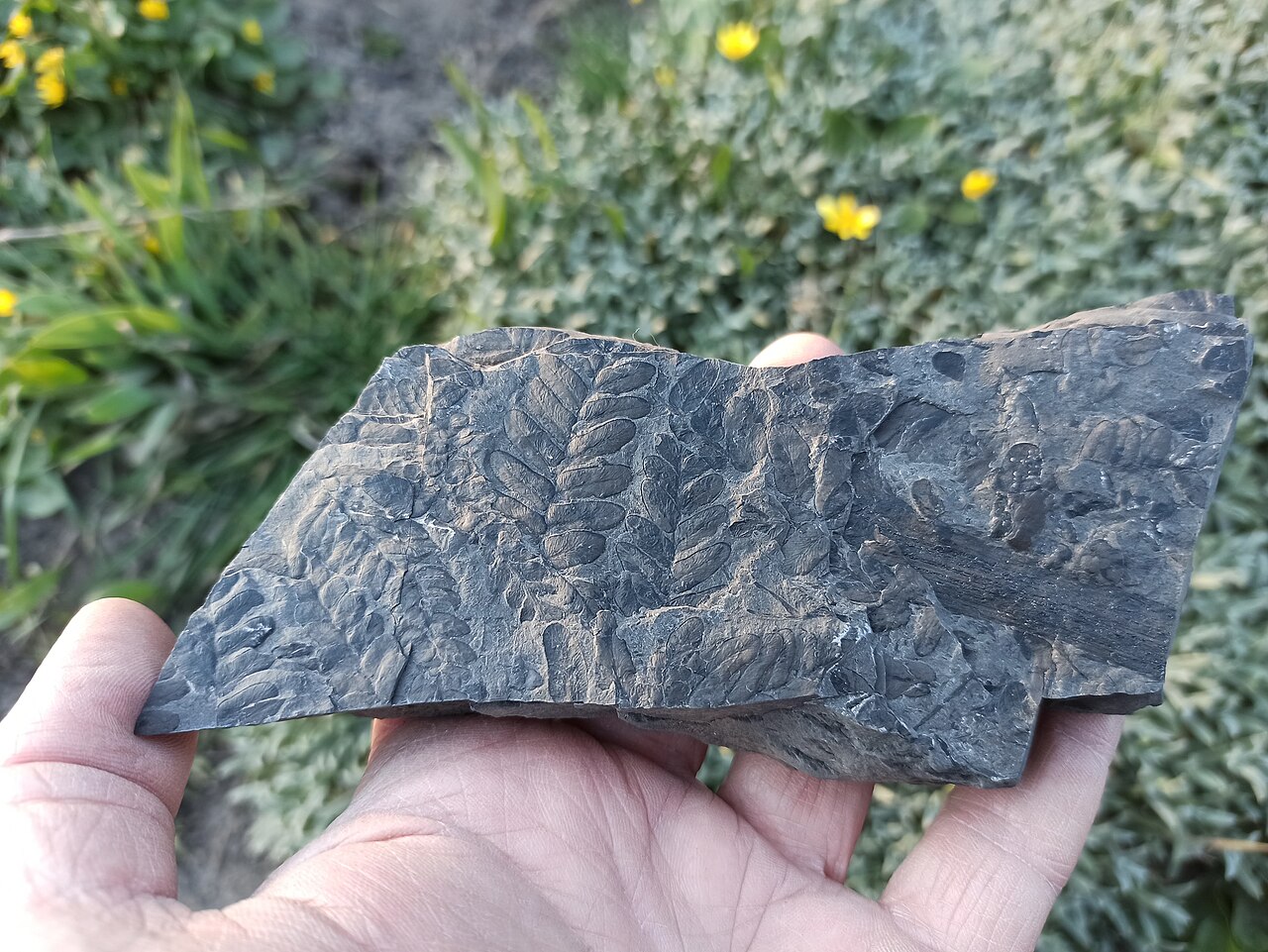
The Ruhr area is built on hard coal, and the coal is a fossil. Around 310 million years ago, in the Late Carboniferous, this was a tropical coastal plain covered in swamp forests. Their dead plant matter turned into coal over millions of years, and the plants themselves survived as impressions in the accompanying shales and sandstones. orecast shows the documented fossil sites and the many historical mining locations nearby.
The typical finds are plants. Fern fronds of the genera Pecopteris and Alethopteris, the ribbed stems of horsetails such as Calamites, and the scaly bark of the tree-sized clubmosses Sigillaria and Lepidodendron. They come out best from clay ironstone nodules, which often split to reveal a clean impression. More rarely the marine bands hold goniatites, relatives of the later ammonites.
The classic place to search is the spoil heaps of the old collieries, where the waste rock from deep underground ended up. Many of these heaps have been landscaped and planted, and some are nature reserves where collecting is not simply allowed, so ask first and stay off fenced ground. To understand the industry that grew on these swamps, visit the German Mining Museum in Bochum or the Zollverein World Heritage site in Essen, where the winding tower and coking plant still stand.
An honest note: the big mines are gone. Germany's last hard coal pit, Prosper-Haniel, closed in 2018. The fossils come from what mining left behind, and finding them takes patience. A clear fern impression in dark shale is a good result. Spoil heaps can slip and are often private RAG land or protected areas, so do not dig without permission, keep off closed sites, and never enter old shafts, which are deadly.
Key
- documented mineral & ore points
- 3347
- fossil sites
- 279
- historical sites
- 1167
310 sites within 45 km are flagged as war or WWII sites with possible unexploded ordnance. Never dig there, it is a danger to life.
Documented finds nearby
- BGR BSK1000: SteinkohleSteinkohle · source: BGR BSK10000 km
- GD NRW RK50 LG: Ton/SchluffTon/Schluff · source: GD NRW RK50 LG0 km
- Ruhrsandstein - Sandstein, meist fein- bis mittelkörnig, auch grobkörnig. Feldspat führend bis feldspatreich, oft mit kohligen Flittern. Die Bindung ist überwiegend kieselig oder tonig-kieselig, untergeordnet tonig oder karbonatisch. Stellenweise Korn-an-Korn-Bindung. (Eignung: Werkstein)Sandstein · source: GD NRW RK50 FG1.8 km
- GD NRW RK50 LG: Ton/SchluffTon/Schluff · source: GD NRW RK50 LG4.5 km
- GD NRW RK50 LG: Ton/SchluffTon/Schluff · source: GD NRW RK50 LG4.6 km
- GD NRW RK50 LG: Ton/SchluffTon/Schluff · source: GD NRW RK50 LG4.9 km
- Ruhrsandstein - Sandstein, meist fein- bis mittelkörnig, auch grobkörnig. Feldspat führend bis feldspatreich, oft mit kohligen Flittern. Die Bindung ist überwiegend kieselig oder tonig-kieselig, untergeordnet tonig oder karbonatisch. Stellenweise Korn-an-Korn-Bindung. (Eignung: Werkstein)Sandstein · source: GD NRW RK50 FG5.5 km
- BGR BSK1000: Kies und SandKies und Sand · source: BGR BSK10005.6 km
- Ruhrsandstein - Sandstein, meist fein- bis mittelkörnig, auch grobkörnig. Feldspat führend bis feldspatreich, oft mit kohligen Flittern. Die Bindung ist überwiegend kieselig oder tonig-kieselig, untergeordnet tonig oder karbonatisch. Stellenweise Korn-an-Korn-Bindung. (Eignung: Werkstein)Sandstein · source: GD NRW RK50 FG5.6 km
- Ruhrsandstein - Sandstein, meist fein- bis mittelkörnig, auch grobkörnig. Feldspat führend bis feldspatreich, oft mit kohligen Flittern. Die Bindung ist überwiegend kieselig oder tonig-kieselig, untergeordnet tonig oder karbonatisch. Stellenweise Korn-an-Korn-Bindung. (Eignung: Werkstein)Sandstein · source: GD NRW RK50 FG5.6 km
- Ruhrsandstein - Sandstein, meist fein- bis mittelkörnig, auch grobkörnig. Feldspat führend bis feldspatreich, oft mit kohligen Flittern. Die Bindung ist überwiegend kieselig oder tonig-kieselig, untergeordnet tonig oder karbonatisch. Stellenweise Korn-an-Korn-Bindung. (Eignung: Werkstein)Sandstein · source: GD NRW RK50 FG5.6 km
- Ruhrsandstein - Sandstein, meist fein- bis mittelkörnig, auch grobkörnig. Feldspat führend bis feldspatreich, oft mit kohligen Flittern. Die Bindung ist überwiegend kieselig oder tonig-kieselig, untergeordnet tonig oder karbonatisch. Stellenweise Korn-an-Korn-Bindung. (Eignung: Werkstein)Sandstein · source: GD NRW RK50 FG5.7 km
- Ruhrsandstein - Sandstein, meist fein- bis mittelkörnig, auch grobkörnig. Feldspat führend bis feldspatreich, oft mit kohligen Flittern. Die Bindung ist überwiegend kieselig oder tonig-kieselig, untergeordnet tonig oder karbonatisch. Stellenweise Korn-an-Korn-Bindung. (Eignung: Werkstein)Sandstein · source: GD NRW RK50 FG5.7 km
- GD NRW RK50 LG: Ton/SchluffTon/Schluff · source: GD NRW RK50 LG5.7 km
Fossil sites nearby
- BochumSenonian · source: PBDB2 km
- Bochum area (Universität Bonn collection)Early Turonian · source: PBDB2.6 km
- Friedrich der Große colliery, shaft 3/4, Hermann 2 seamWestphalian A · Bochum · source: PBDB9.3 km
- Westphalian Pläner (Ziegler collection)Late Turonian · source: PBDB9.3 km
- Essen (Mittelcenoman)Middle Cenomanian · Essener Grünsand · source: PBDB11.8 km
- Essen-on-the-Ruhr (BMNH collection)Hauterivian · source: PBDB12 km
- Schmiedestraße quarry, HaßlinghausenMarsdenian · Upper Hagen Beds · source: PBDB13 km
- Dortmund-Bochum railway guard house (Dorstfeld quarry)Late Turonian · source: PBDB14.2 km
- Hauptfloez seam, St. Hubertus mineNamurian · Sprockhoeveler · source: PBDB14.4 km
- Essen GreensandCenomanian · source: PBDB14.5 km
Collecting, law & safety
A promising geology is never a guarantee, and you will not find invented numbers here. Collecting and digging are regulated across Europe and usually need a permit. Protected sites, nature reserves and disused mines are off-limits and can be deadly.
Frequently asked questions
Which fossils occur in the Ruhr area?
Mostly Carboniferous plants: ferns, horsetails and the scaly bark of clubmoss trees, often inside clay ironstone nodules. Animal fossils such as goniatites are rare. The coal itself is essentially compressed plant matter.
Where can you search for fossils in the Ruhr?
Traditionally on the colliery spoil heaps, but many are now planted over or protected and not freely accessible. Ask the municipality or the owner first. Museums like the Mining Museum in Bochum show what to look for.
Why is there coal and so many fossils here?
In the Late Carboniferous a tropical coastal swamp forest stood here. Its plant matter became coal, and the plants left their imprints in the rock. That is why the region is so rich in Carboniferous flora.
More guides:
- Gold & ore in the Harz
- Silver & minerals in the Ore Mountains
- Fossils of the Swabian Alb
- Gold & minerals in the Black Forest
- Volcanoes & geology of the Eifel
- Fossils in Solnhofen & the Altmühl valley
- Gold panning in the Alps & Austria
- Finding amber on the Baltic coast
- Agate & gemstones in Idar-Oberstein
- Find fossils near me
- Gold panning near me
- Rockhounding near me
- How to identify fossils
- How to identify rocks and minerals
- Collecting fossils and minerals: allowed or not?