 orecast
Fossils in Solnhofen & the Altmühl valley
Where can you find fossils around Solnhofen and in the Altmühl valley in Bavaria? The Solnhofen limestone of the Late Jurassic is one of the best-known fossil sites in the world. Its thin slabs have produced fish, pterosaurs and Archaeopteryx, the first known bird.
Open the map for this region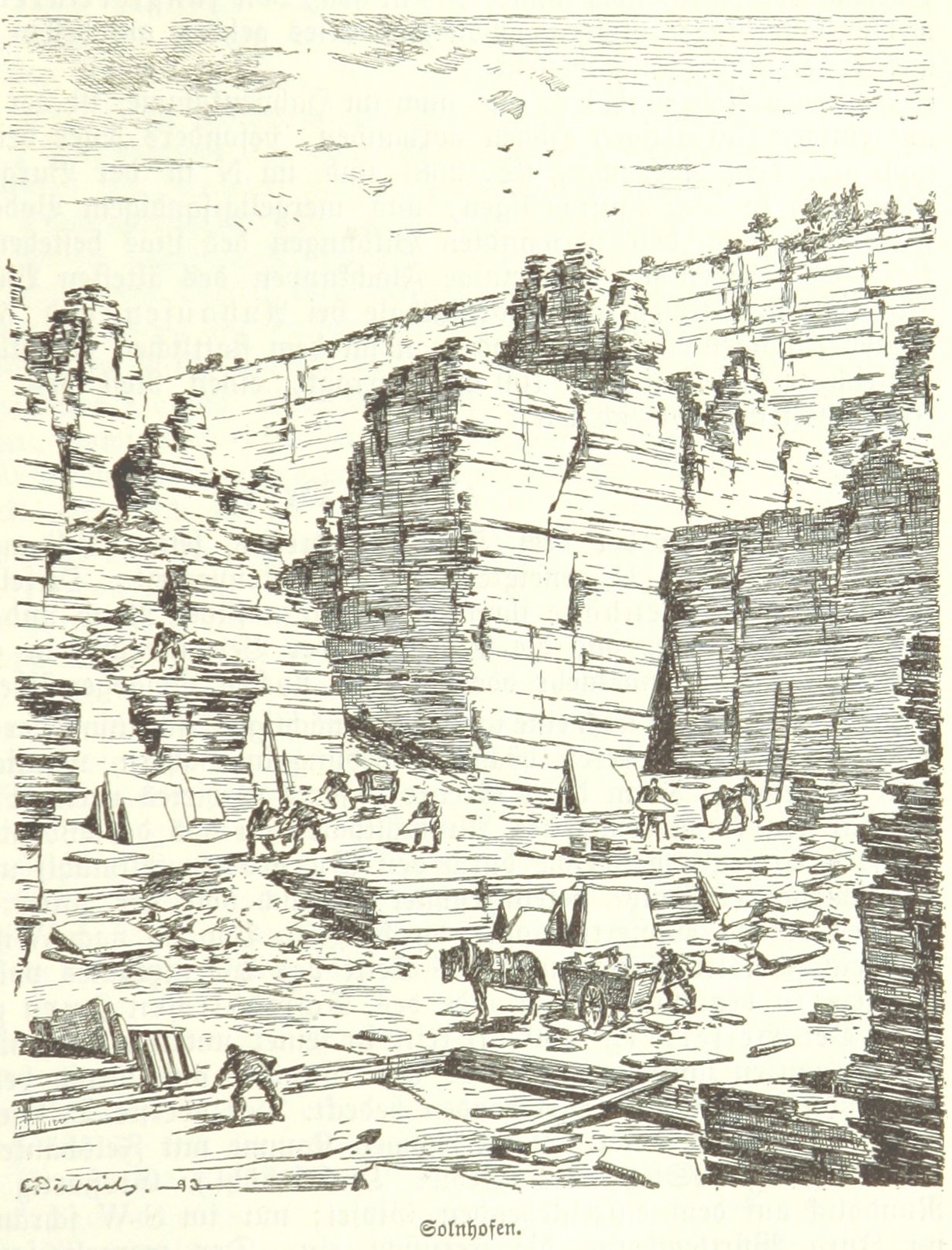
About 150 million years ago a shallow tropical lagoon covered this part of Bavaria. Almost nothing decayed on its oxygen-poor floor, and the fine lime mud sealed in every animal that sank into it. The result is the Solnhofen limestone, a rock that splits into paper-thin slabs and has preserved impressions down to feathers and jellyfish. Geologists call exceptional sites like this Konservat-Lagerstätten, deposits of extraordinary preservation. orecast shows the documented fossil sites nearby and the formations that hold them.
The region owes its fame to Archaeopteryx. The first skeleton of this early bird turned up in 1861 near Langenaltheim, in the belt of quarries between Solnhofen and Eichstätt. Around a dozen specimens are known today, nearly all of them from this narrow strip of country. For centuries the limestone was quarried not for its fossils but as lithographic stone for printing and as flooring. The famous finds came out as a by-product of that work.
To split slabs yourself, head for one of the visitor quarries. At the municipal hobby quarry in Solnhofen, in Langenaltheim and on the Blumenberg near Eichstätt you pay a fee, borrow a hammer and keep what you find. The Mühlheim visitor quarry near Mörnsheim has been closed since November 2024. Realistic finds are small fish of the genus Leptolepides, crustaceans, the odd ammonite and plant remains. A pterosaur or a feather is the rare exception that many a collecting season never turns up. To see the best pieces, visit the Jura-Museum on the Willibaldsburg in Eichstätt or the Bürgermeister-Müller-Museum in Solnhofen, which keeps an Archaeopteryx of its own.
Come with modest expectations and a free afternoon. A cleanly preserved fish a few centimetres long makes a good day, and that is the appeal, because it lay untouched in the stone for 150 million years. One local rule matters: scientifically important finds, such as a vertebrate skeleton, must be reported under Bavarian heritage law. On the supervised splitting sites everything is allowed and explained. Working quarries and private ground are off-limits without permission, and loose rock faces are dangerous, so never dig beneath them.
Key
- documented mineral & ore points
- 16
- fossil sites
- 438
- historical sites
- 652
18 sites within 40 km are flagged as war or WWII sites with possible unexploded ordnance. Never dig there, it is a danger to life.
Documented finds nearby
- BGR BSK1000: Kalkstein und DolomitsteinKalkstein und Dolomitstein · source: BGR BSK10000 km
- BGR BSK1000: sonstige Industriemineralesonstige Industrieminerale · source: BGR BSK10009.4 km
- BGR BSK1000: Ton, TonsteinTon, Tonstein · source: BGR BSK100013 km
- BGR BSK1000: sonstige Metamorphitesonstige Metamorphite · source: BGR BSK100016.2 km
- BGR BSK1000: Kies und SandKies und Sand · source: BGR BSK100016.7 km
- BGR BSK1000: Ton, TonsteinTon, Tonstein · source: BGR BSK100018.9 km
- BGR BSK1000: Ton, TonsteinTon, Tonstein · source: BGR BSK100020.8 km
- BGR BSK1000: Kies und SandKies und Sand · source: BGR BSK100022 km
- BGR BSK1000: Kies und SandKies und Sand · source: BGR BSK100023.7 km
- BGR BSK1000: sonstige Metamorphitesonstige Metamorphite · source: BGR BSK100023.7 km
- BGR BSK1000: Ton, TonsteinTon, Tonstein · source: BGR BSK100025.6 km
- BGR BSK1000: ÖlschieferÖlschiefer · source: BGR BSK100027.2 km
- BGR BSK1000: ÖlschieferÖlschiefer · source: BGR BSK100028.5 km
- Leonie MineEisen · active producer · source: USGS MRDS31.9 km
Fossil sites nearby
- SolnhofenTithonian · source: PBDB0 km
- Mörnsheim radiolarians, SolnhofenEarly Tithonian · Mörnsheim · source: PBDB1.1 km
- oldest Solnhofen quarryEarly Tithonian · Solnhofen · source: PBDB1.1 km
- Solnhofen RadiolariansEarly Tithonian · Dachhornstein · source: PBDB1.9 km
- Mörnsheim quarry, Solnhofen (Jura Museum JME collection)Early Tithonian · Solnhofen · source: PBDB2.2 km
- Mörnsheim tracks (PROXY)Early Tithonian · Solnhofen · source: PBDB2.2 km
- Quarry 1.3km E of Übermatzhofen, PappenheimAquitanian · source: PBDB2.6 km
- Langenaltheim quarryEarly Tithonian · Altmühltal · source: PBDB2.9 km
- Langenaltheim quarry (Maxberg specimen)Early Tithonian · Altmühltal · source: PBDB2.9 km
- Langenaltheim quarry (SMNS)Early Tithonian · Solnhofen · source: PBDB2.9 km
Collecting, law & safety
A promising geology is never a guarantee, and you will not find invented numbers here. Collecting and digging are regulated across Europe and usually need a permit. Protected sites, nature reserves and disused mines are off-limits and can be deadly.
Frequently asked questions
May I collect fossils in Solnhofen myself?
Yes, at the visitor quarries in Solnhofen, Mörnsheim and on the Blumenberg near Eichstätt. You pay a fee, get tools and keep your finds. Commercial quarries and private land are off-limits without permission.
Which fossils really turn up in the Altmühl valley?
Most often small fish, crustaceans, ammonites and plant remains. Pterosaurs, feathers or a bird are extremely rare and usually the work of professional excavations. A tidy fish is a good result for a day at the splitting site.
What makes the Solnhofen limestone special?
It formed on the floor of an oxygen-poor lagoon and preserves even soft body parts as fine impressions. That is why jellyfish, insect wings and Archaeopteryx survive here. Sites of this quality are called Konservat-Lagerstätten, and there are only a handful worldwide.
More guides:
- Gold & ore in the Harz
- Silver & minerals in the Ore Mountains
- Fossils of the Swabian Alb
- Gold & minerals in the Black Forest
- Volcanoes & geology of the Eifel
- Gold panning in the Alps & Austria
- Fossils in the Ruhr area
- Finding amber on the Baltic coast
- Agate & gemstones in Idar-Oberstein
- Find fossils near me
- Gold panning near me
- Rockhounding near me
- How to identify fossils
- How to identify rocks and minerals
- Collecting fossils and minerals: allowed or not?