 orecast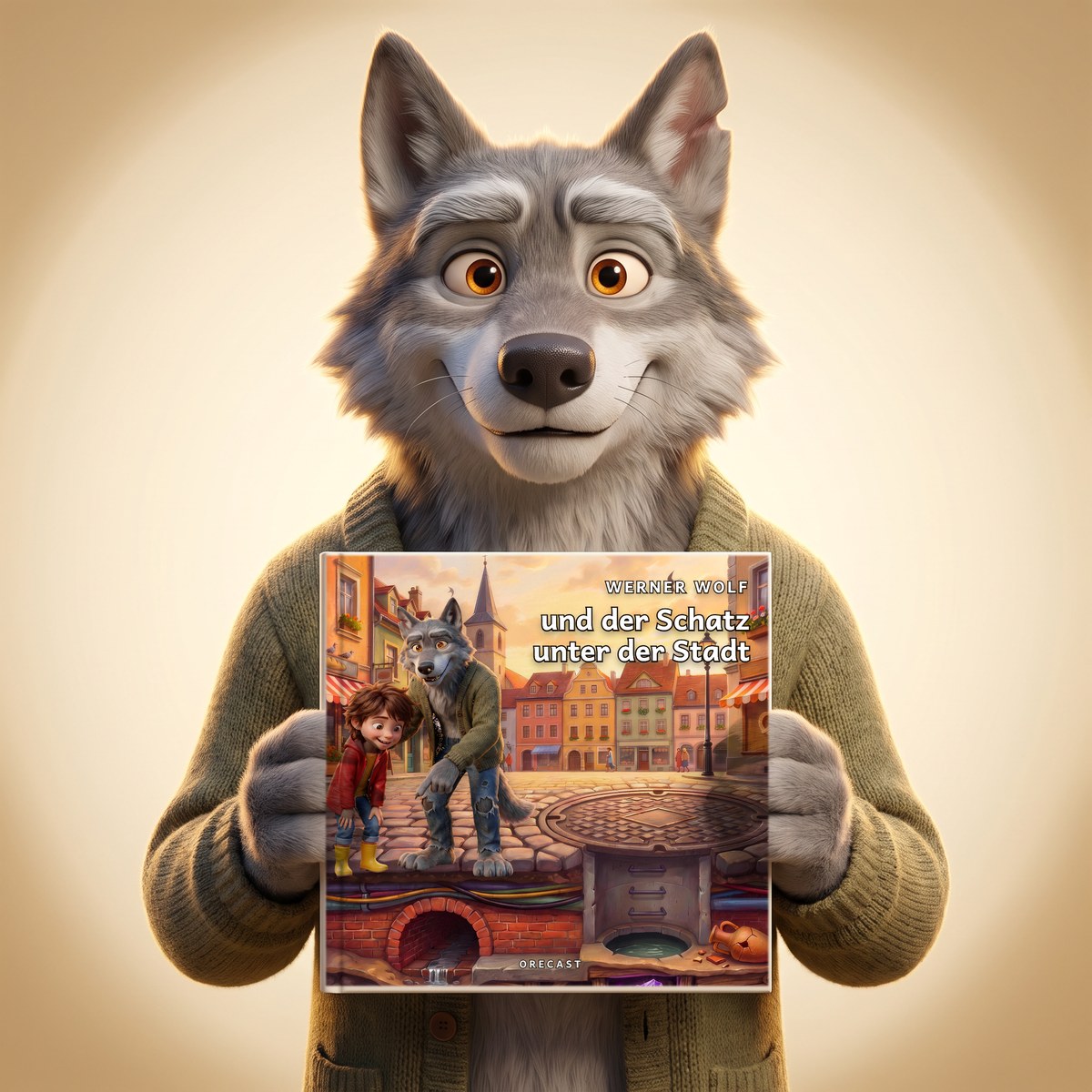
A database turned into a children's book. “Werner Wolf and the Treasure under the City” takes children from the age of six on a journey straight down: through pipes, a Roman road, a silver mine and a sea that long ago turned to stone. And everything in it is real.
The question that started it
Children ask the best question of all when they stand on a street: what is actually down there? Grown-ups usually answer “tarmac” and change the subject. Yet the honest answer is far more interesting, and it is the reason ORECAST exists. Beneath any point you stand on lies a sequence of layers, each with its own story: first what people laid down in the last hundred years, then what earlier people left behind, and below that what the earth itself deposited over millions of years.
Our app shows exactly that sequence for any point in Europe. But a map full of find markers is not something you read to a six-year-old at bedtime. So we translated the same idea into a story.
Werner Wolf and Kai
Viewers of our channel already know Werner Wolf: an old, kind wolf in a grey knitted cardigan and torn jeans, with a nose that smells what lies deep underground. In the book he is joined by Kai, a child with tousled hair, a red jacket and yellow rubber boots. Whether Kai is a boy or a girl is deliberately never revealed. Children should be able to step into the story whoever they are.
The two meet on a city square, Werner lifts a manhole cover, and from there it goes down and down. Every spread is a new layer, and every layer has a ladder. You always see where they came from and where the way continues. That seemingly small decision turned out to be the most important one in the whole book: children grasp spatial relationships immediately when you show them rather than assert them.
Six layers, all of them real
Directly below the paving run the utility lines: water, gas, power and fibre, each in its own sand-bedded trench. Deeper down lies the brick sewer, reached by the shaft beneath the manhole cover. That is not artistic licence but the real build-up of a European street, and we drew it that way on purpose.
Deeper still it becomes archaeological. In Cologne the Roman road sits roughly six to ten metres below today's level, about the height of a three-storey house, only downwards. In the book Kai finds a broken amphora, a mosaic and a coin there. And learns the rule that matters most in this book.
Below that comes an old silver mine with timber beams, an ore cart and amethyst geodes glowing purple out of the rock. Then a fossil cave: a large ammonite sits in pale limestone, and in a thought bubble Werner and Kai see the warm sea that covered much of southern Germany some 180 million years ago, with ichthyosaurs and a plesiosaur. At the very bottom the rock turns warm, and Werner says the line the whole book is built around: down here the earth itself is the treasure.
Look, don't dig
A children's book about hidden treasure could easily send readers out with a spade. That is why a clear rule sits at the heart of the story. When Kai asks whether they can take the Roman coin, Werner answers: “No. Treasures from long ago belong in a museum. We look — we don't dig.”
That is not invented morality but the law and archaeological practice: a find loses nearly all its scientific value the moment it leaves the ground undocumented. The information is not the object, it is the layer it sat in. This attitude runs through everything we do. The map shows what is documented, and says just as plainly where nothing is on record.
Rudy and the art of re-reading
To survive its twentieth bedtime, a picture book needs more than a story. So on every underground spread Rudy the earthworm hides exactly once, wearing his red woolly hat. At the Romans he wears a legionary helmet, in the fossil cave a snorkel mask, in the mine he carries a cup of coffee. There is also a mole in a hard hat, a rat with cheese in the sewer, a sleeping bat, a rabbit burrow with a tiny family photo, and an ant trail carrying removal boxes. A closing page reveals everything there is to find.
And because the questions come after the reading, a dedicated knowledge page answers the most common ones: how deep are the Romans really? Why is old material always at the bottom? Was there truly a sea here? The answers are short, honest and free of invented precision, the same rule as in the app.
How the book was made
The illustrations were created with the help of image AI and then reworked, composited and checked page by page. That is no secret; it is stated in the book's imprint. What is more interesting is where the actual work went: not into generating pictures, but into establishing reliability. Making sure the ladder continues on every level. That a shaft sits beneath every manhole cover. That the utility lines lie the way they really lie. That an ammonite does not turn up in the wrong layer.
In the end a three-stage review checked every page for anatomy, visual logic and text, with the same care we apply to datasets. A children's book forgives nothing: children spot every extra paw.
Now available
The book has 24 pages, is square at 17 × 17 centimetres, printed in full colour throughout, and is aimed at children from six, for reading aloud and for first solo reading. The German edition is now available on Amazon (affiliate link: as an Amazon Associate, ORECAST earns from qualifying purchases, and your price stays the same); all details are on our book page.
If you want to know what lies beneath your own town in the meantime, that is exactly what the map is for. It shows, for any point in Europe, which minerals, fossils and historical traces are documented there, and where nothing is on record at all.
Illustrations generated with AI.